
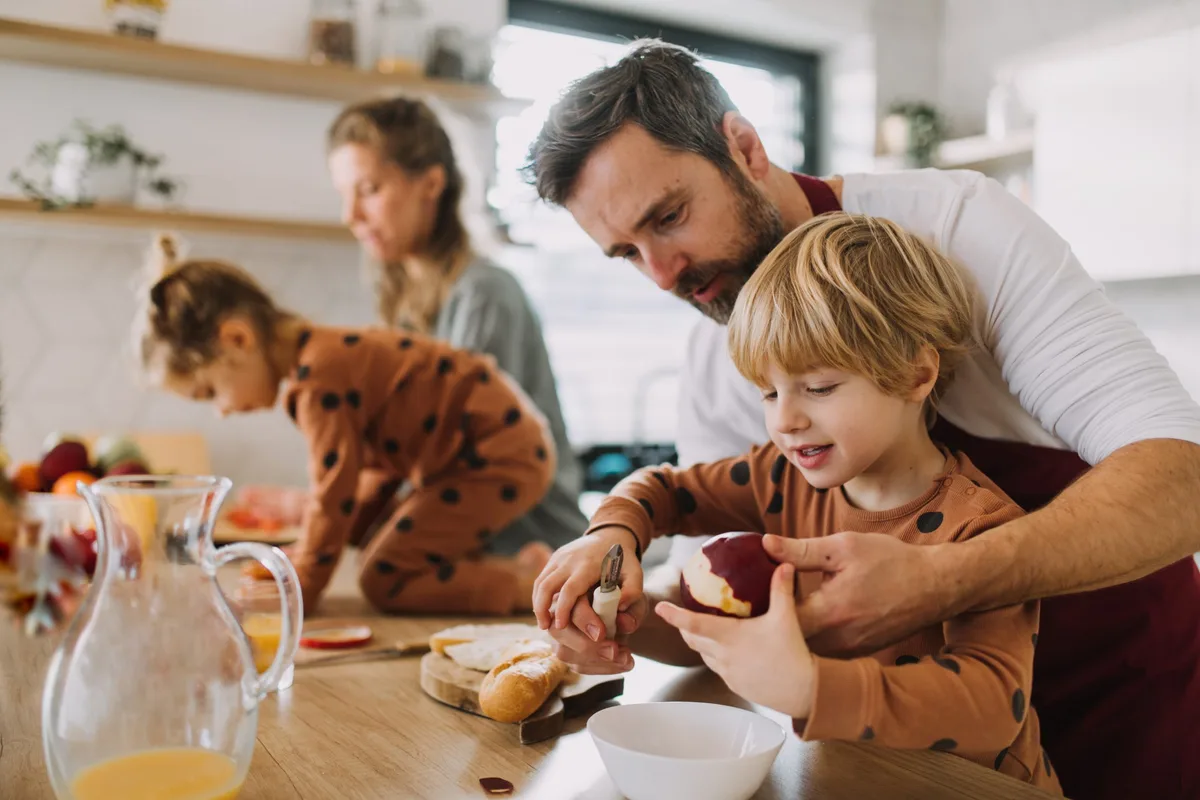
How to set a good example at mealtimes
Anyone who reads my articles regularly will have seen the following sentence many times: «Set a good example.» It may be a cliché, but nevertheless, hardly any other piece of advice is as reliable in everyday family life.
Children learn by imitation, including when it comes to eating. Eating with enjoyment, curiosity and relaxation shows your child that eating can be fun – and lays the foundation for a healthy relationship with food.
Children mirror our behaviour
Parents know these moments: your child wrinkles their nose at their vegetables, but you remain calm. What they perceive more strongly than words in such moments is our behaviour. If we eat with enjoyment, try new things and remain relaxed, they will often adopt this attitude automatically. If we show scepticism or enforce strict rules, they will sense this just as clearly – and react defensively.
Children are born imitators. Even as toddlers, they look to their caregivers for guidance and copy their facial expressions, tone of voice and eating habits. In learning psychology , this is known as «modelling»: children observe which behaviours are met with approval.
What parents do is more important than what they say.
Studies show that children whose parents eat fruit and vegetables every day are more likely to adopt this habit themselves – without any nagging. What parents do is more important than what they say. Those who show curiosity and try new things at the table send the message that eating can be exciting and varied.
Did you know that children need to try a new food eight to ten times on average before they like it? Patience pays off – it's best for parents to try it too.
Diversity on the family table
Children who are exposed to a variety of flavours at an early age are often more open to new things later on. This openness grows in everyday life: when shopping, cooking and eating together. Cutting chillies, tasting lentils or trying sushi for the first time with children creates positive experiences that will remain in their memories. This makes eating a discovery, not a chore.
Eating is more than just consuming food: it is culture, community and a reason to talk. When children experience meals as a way of creating bonds, they remain curious, even as they get older and decide for themselves what to put on their plates. Involving children in cooking also strengthens their
Self-confidence: Peeling carrots or cutting out biscuits are small tasks with a big impact.
Books with simple, illustrated recipes that provide step-by-step guidance, such as the new Globi and Betty Bossi cookbook, offer inspiration for child-friendly cooking . This helps children learn to take responsibility and have a say in the kitchen.
In a world full of advice and dos and don'ts, it's easy to forget that eating should be enjoyable. Children learn from us whether eating is something pleasant or something stressful. Those who constantly count calories or evaluate food while eating unconsciously convey tension. This inhibits curiosity and can weaken body awareness.
- Be a role model: enjoy your food – without pointing fingers.
- Together instead of apart: Use meals as family time, not as a point of contention.
- Stay calm: don't make a big deal out of «unhealthy» foods – balance is what counts over the week.
- Encourage curiosity: make new things a little adventure, not a chore.
- Involve children: let them help with the cooking, choose the ingredients and taste the food.
- Storytelling: Bringing food to life – «This lentil comes from India...»
Enjoyment is also education
Enjoyment competence means eating consciously – without feeling guilty. Those who treat themselves to a piece of chocolate every now and then and visibly enjoy it show that enjoyment is allowed and part of a balanced diet. No food is «forbidden» per se; what matters is balance over time.
Young people are increasingly reluctant to eat «unhealthy» foods for fear of doing something wrong. Experts are observing a growing obsession with healthy eating, which can put a strain on social relationships. A relaxed attitude at the family dinner table can help prevent this.
Lead by example instead of prohibiting
Children develop a stable sense of satiety and taste when they are guided with confidence. Parents who remain curious and show composure open up opportunities for children to gain experience and gradually develop their own tastes.
Rigid rules and negative labels are not helpful. They reinforce black-and-white thinking and encourage secret eating. Language that combines freedom and guidance is more effective.
book recommendation

Whether it's chicken and mushroom patties, Globi biscuits or frog sandwiches – the cookbook «Globi and Betty Bossi» has delicious recipes for young and old alike. And best of all, the matching Globi cookie cutter is included in the set.
