
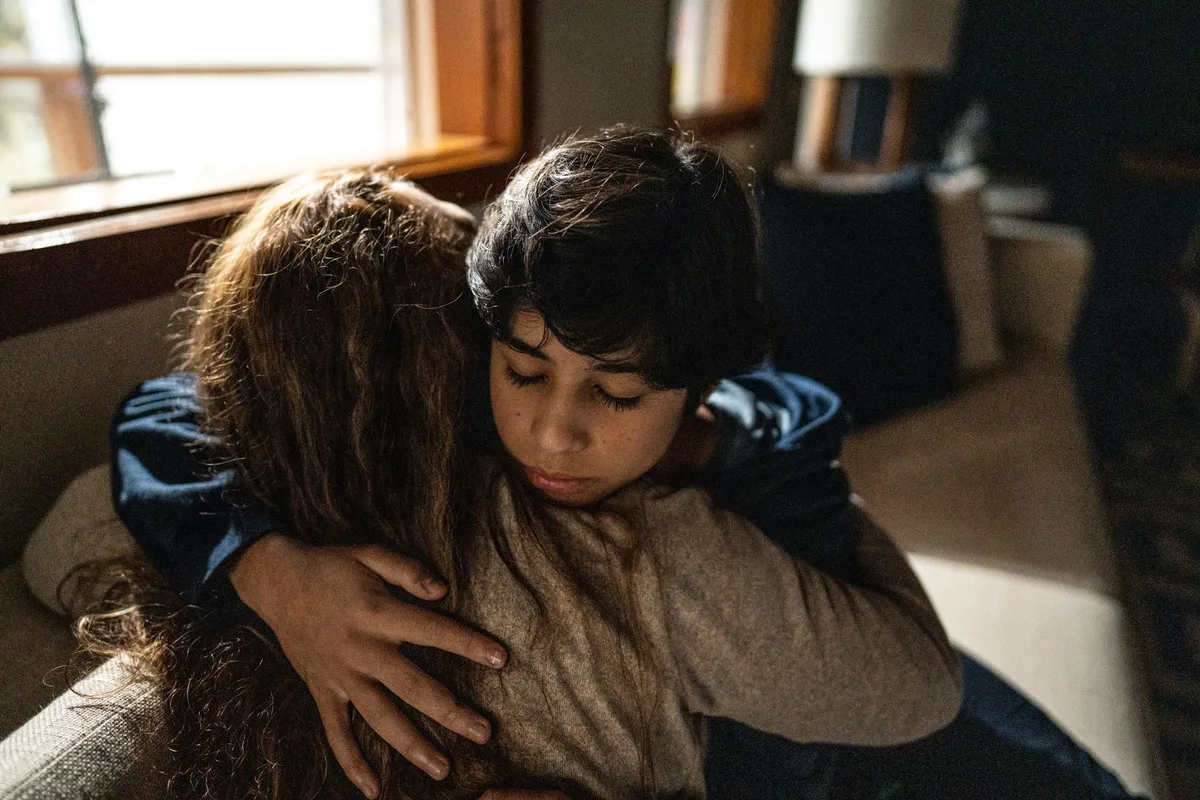
According to psychologist Paul Ekman, joy, sadness, disgust, fear, surprise, anger and contempt are considered to be the basic human emotions. These often «overwhelm» us without us being able to do anything about it. It is therefore important to teach children how to deal with them.
Fear feels stupid, but it doesn't mean there's something wrong with you.
Studies show that the better a feeling can be named, the more likely it is to lose intensity and the easier it is to control. Parents should therefore talk to their children about feelings, explain where they come from and how to recognise them.
Instead of dismissing them with phrases like «It's not that bad» or «Don't be silly,» feelings should be acknowledged for what they are: «Fear feels stupid, but it doesn't mean there's something wrong with you.»
How to help your child during a panic attack
Heart palpitations, sweating, blushing, cramps in the fingers, the feeling of not being able to breathe – an acute anxiety or panic attack can be very frightening for children. It is important that parents do not react with fear themselves and perhaps even call the emergency services.
«That would only increase the child's fear,» says Gregor Berger, a child and adolescent psychiatrist in Rapperswil-Jona. Instead, you should remain calm, avoid dramatising the situation, and still take the fear seriously.
During a panic attack, simple messages are important: I am here. Everything will be alright.
At that moment, it is important to convey to the child that this is an overreaction of the body and that it will pass. You can sit down together and endure the situation, create sensory stimuli with prompts such as «Come on, stroke my hand» to break the cycle of thoughts, and repeatedly reassure them that although it feels bad, you will get through it together.
«Breathing exercises are very effective in such moments, and if the child says they are dying, you remain calm and tell them that they are not going to die,» says Gregor Berger. «You have to be aware that the child cannot think clearly in this situation, so simple messages are important: I am here. Everything will be fine.»
Further reading
- Swiss Society for Anxiety and Depression, SGAD: Lots of information for young people affected by anxiety and relatives of anxiety patients.
- Pro Juventute: Tips and background information for parents of children and young people with anxiety disorders: Overcoming fears.
- Hendrik Büch, Manfred Döpfner: Social Anxiety and Performance Anxiety. Hogrefe 2015, 189 pages, approx. £35.
- Wilhelm Rotthaus: Fears of children and young people: Recognising, understanding, resolving. The parents' book. Carl-Auer 2021, 105 pages, approx. £25.


