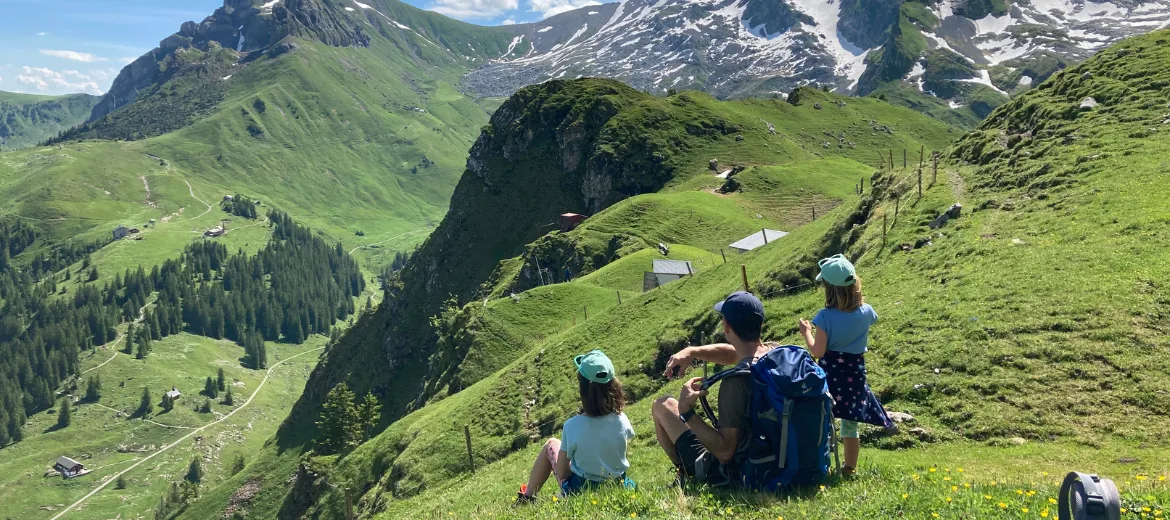
Holidays with children aren't always relaxing. Especially not when a child has a rare illness. Lying on a beach towel by the sea, a book in one hand and an iced coffee in the other, soaking up the sun – I've had to let go of that idea ever since the birth of our third child.
But now I'm amazed at just how carefree this year's summer holidays turned out to be. There was one major difference, after all: our daughter travelled without a nasogastric tube for the first time. But first, let's take a look back.
A nasal tube throws a spanner in the works for holiday plans
We had planned our trip to Italy well in advance last year. As I have since learnt, plans can change more quickly than you might think. That's exactly what happened when my daughter had to have a nasogastric tube fitted because of her health.
We both spent a whole week in hospital because, whilst we were there, they carried out various tests as well. Watching that tube being inserted through my nose and down into my stomach made me feel nauseous and dizzy. I had to sit down; tears were streaming down my face. And I knew for certain: I would never do that. But, as is so often the case, things turned out differently.
We didn't want our daughter's illness to determine whether our family could go on holiday.
Our «well-planned» summer holidays began exactly one week after she was discharged from hospital. We knew these holidays would be different. Nevertheless, we wanted to go. Not because we underestimated the risks, but because we didn't want our daughter's illness to dictate whether our family could go on holiday. Besides, we didn't want to let her older siblings down.
At the same time, we were aware that the nasal tube could be pulled out at any moment, in which case we would have to go to the Italian hospital, which was just under two hours away. So we had only one goal: to keep the tube in place.
We had a three-day grace period. Then her body started spitting the tube feed back out in a stream.
Travelling by car was a good decision, despite the long journey. How else could we have managed to sneak litres of tube feed and kilos of equipment into our hand luggage? Buying a roof box beforehand also proved to be a great help.
With all the medically necessary boxes, our boot was already almost bursting at the seams. We had estimated the journey would take around seven hours. At the time, we didn't realise that we would have to stop every three hours for 45 minutes to administer tube feeding via the feeding pump. The rest we had hoped for was not to be, at least not at first.
Carrying out medical procedures yourself
We had a three-day grace period. Then her body started spitting the tube feed back out in a stream. Our visit to the Sea Life Aquarium went something like this: our two toddlers ran ahead, whilst we, with our youngest in our arms, wiped up a new puddle with tissues every few metres – in the hope of being quicker than the other visitors, who might slip on the fresh vomit. To be honest, it wasn't very relaxing.
What we were still missing happened the very next night. When I got up, the probe was lying in her cot – a long way from her nose. Try as I might, I couldn't bring myself to imagine making the two-hour drive to hospital, only to end up sitting around for hours in an Italian A&E department. Fortunately, we still had one last resort.
As luck would have it, we'd got to know a family at our campsite whose mother was a nurse. And so, without further ado, she showed me how to insert the nasogastric tube myself. I was relieved – and hated it at the same time. I was deeply reluctant to cause my daughter this pain, even though I knew it was vital for her survival.
But I grew more confident with each attempt. The tube didn't stay in place as well as we'd initially hoped. My husband and I learnt to carry out medical procedures ourselves: I inserted the tube, whilst he held its tip in place. At the same time, our two older children had to learn that our holidays sometimes didn't go to plan and that an outing would have to wait if their sister's needs suddenly took priority. These holidays weren't about relaxation; they were about learning to rise to the challenge – each in our own way.
Never have to insert a catheter again!
A year later, this July, we embarked on the summer holiday project once again. Over the past few months, we have pushed ourselves far beyond our limits and learnt to adapt to our daughter's changing medical challenges.
The biggest change was the switch from a nasogastric tube to a PEG tube. This means that the tube no longer goes down through the nose, but has been surgically inserted through the abdominal wall into the stomach. The good thing about this is that I'll never have to insert a tube again!
Our family holidays don't need to be perfect – they need to be flexible.
Consequently, we set off on our holiday feeling less stressed. This time, we even had a twelve-hour drive ahead of us. Because this year, too, the same rule applied: good planning can quickly go out of the window. Four days before we were due to set off for France, we received the news that the holiday home we'd booked had burnt down in a forest fire. Finding a replacement at such short notice, however, proved rather difficult. In the end, we were still able to set off on our holiday a week late – albeit not quite as planned: the travel operator promptly rebooked us to Croatia.
We can't control everything
With a boot full of medical equipment and the necessary medical certificates to cross the border, we were ready to embark on our adventure. This time, we knew we didn't have to be prepared for every eventuality. Sometimes it's enough to trust that a solution will be found. We realised that our family holidays don't need to be perfect, but rather flexible – even if we still had to plan carefully.
For us, the only option was a destination that was accessible by car and had good medical facilities nearby. At the same time, we had learnt that safety doesn't mean having everything under control. We can take equipment, food, documents and emergency plans with us. But we cannot prevent a probe from falling out – or a holiday home from burning down. We can only learn to deal with whatever happens – even if it frightens us at first.
We realised that, in the meantime, it wasn't just our daughter who had grown, but we too had grown in our roles. And perhaps that is precisely why our most recent holiday was both restorative and relaxing – and one during which I was often seen with an iced coffee or a book in my hand.
Rare diseases
Rare diseases are conditions that affect only a small number of people (no more than 5 in 10,000). In total, there are around 8,000 known rare diseases. Although each one is rare in its own right, several hundred million people worldwide – around half a million in Switzerland – are affected.
Many are genetically determined and often begin as early as childhood. They are typically characterised by a chronic course and a wide variety of symptoms, which often makes diagnosis difficult. As a result, many of those affected go through a long process of trying to find the correct diagnosis. For parents of an affected child, this often means an emotionally stressful period full of uncertainty.
There is no cure for many rare diseases, but for some there are treatments to manage the symptoms.
You can find further information here:
- https://www.kmsk.ch/
- https://www.proraris.ch/
- https://www.stiftung-seltene-krankheiten.ch/home
- https://www.raredisease.ch/
- https://www.kosekschweiz.ch/