
Parents with a neurodivergent child face many hurdles in their everyday family life. Families who care for anxious or shy children experience similar challenges. One of these challenges is learning to swim.
In my work as a paediatrician, I have increasingly encountered parents in recent years who tell me with frustration that they had to discontinue their child's swimming lessons. They say the rules are too rigid and that too little attention is paid to their children's needs.
Is the child struggling with transitions? Does it need support? Not possible. Is the child sensory overwhelmed? Does it want to take off its swimming cap? Not possible.
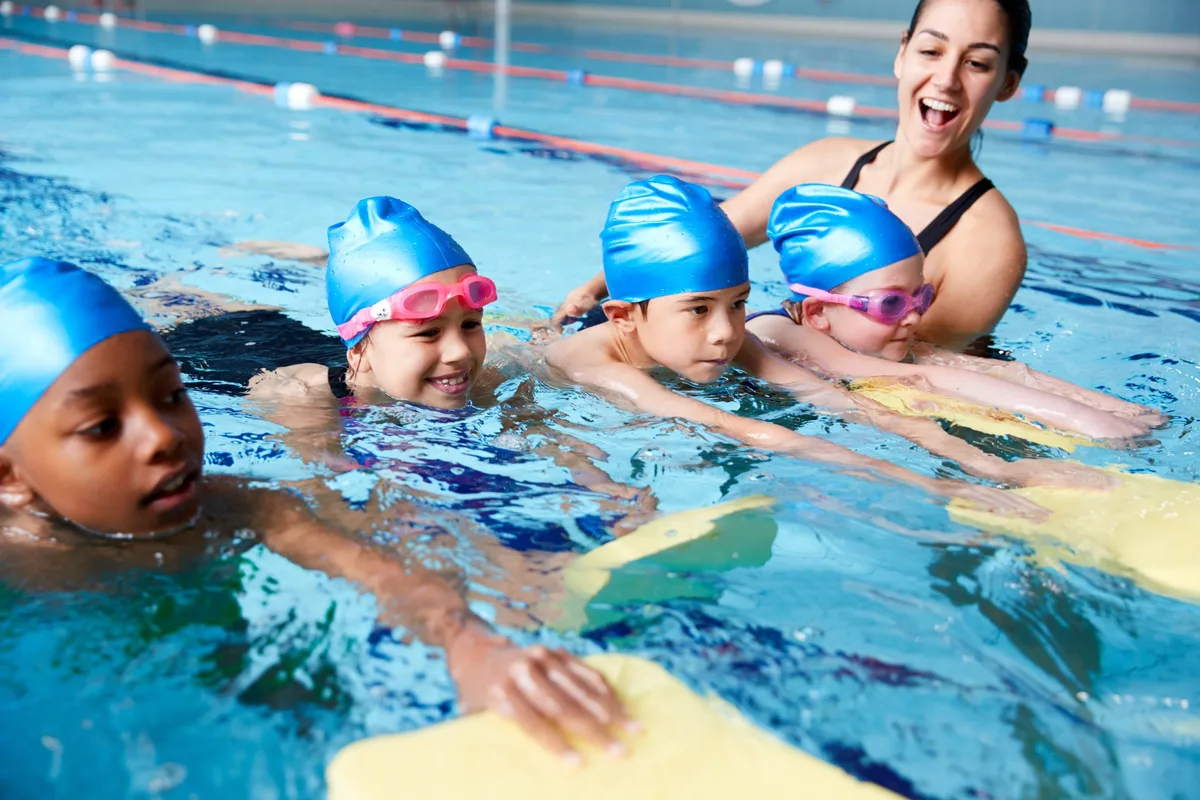
How can inclusion be achieved in swimming lessons? What skills should a teacher have, and what can parents do to help their child succeed in the course? To answer these questions, I accompanied a mother to a private swimming lesson with children aged between seven and eight.
Start with tears
What was possible there with just a few gestures and a lot of empathy touched me deeply. I would like to share this experience and my professional assessment.
Seven children sit waiting on a bench at the edge of the pool. Most of them seem relaxed, watching the goings-on in the indoor swimming pool with interest. Miles* chews his fingernails nervously and swings his legs back and forth. Nina* sits at the edge of the group, clinging anxiously to her mother.
Ben*, the eighth child in this group, is not yet in his place. The boy, who is on the autism spectrum, is hiding behind a pillar and watching the scene from a safe distance. Like Nina, he is one of the older children in this group. In addition to swimming trunks, he is wearing a long-sleeved UV shirt and his hair is long enough that he can hide his face under it at any time.
Mrs Meier, the swimming instructor, now begins to hand out the swimming caps and helps the children put them on. The first five children are now wearing neon green caps with the swimming school logo and look happy. When it is Nina's turn, she lowers her head and a tear runs down her cheek.
Ben always swims further than the prescribed distance. It acts as an outlet for him, as he can satisfy his strong need for autonomy.
«If you don't want to wear a swimming cap, that's fine. But if you want, I can briefly explain what it's for,» says the swimming instructor. Nina nods cautiously. Ms Meier crouches down and explains the purpose of the cap in a few sentences. «I'd rather not wear a cap,» says Nina at the end. Ms Meier nods and makes Nina feel that it's really okay.
Next, Miles is allowed to put on his cap. To do this, he holds his hands in front of his face, forms them into small fists and places his thumbs next to each other, just as he learned in the last lesson. Mrs Meier puts the swimming cap over his head; it fits and Miles is ready for the lesson.
Praise, encourage and comfort
Ben, who has now ventured out from his hiding place behind the pillar, is sitting on the bench a little way away from the group, hidden behind his mother's back. «Nice to see you, Ben,» calls the teacher. «No cap, right? I remembered that from last time,» she says and smiles at him.
The first exercises begin. Ben only dares to approach the edge of the pool when accompanied by his mother, but then wants to be the first to perform the exercises. The teacher smiles at him and praises him every time. «Great, Ben, you did really well.» She also praises, encourages and comforts the other children when things don't go so smoothly.
It's not that easy to dive, exhale, make the right arm and leg movements, and then lift your head again to inhale without swallowing too much water. The children first swim five metres, then eight, and finally ten, leaving the pool at the designated spot to get back in line.
Except for Ben. He swims a little further each time, even though he knows where the course ends. With a wink, Mrs. Meier remarks, «You're doing so well that you can even swim longer distances!» She doesn't reprimand him.
Every child has their own needs
Nina is not in the pool yet. She has remained sitting on the bench next to her mother; her anxious face speaks volumes. «If you want, you're welcome to give it a try. It's perfectly fine if you don't dive,» the teacher encourages her. Nina listens attentively. «You are welcome to accompany her in everything and also get into the water,» she adds, addressing Nina's mother; «the important thing is that Nina feels comfortable.»
During each exercise, Ben makes sure that he is allowed to perform first and stands at the very front on the right when there are two groups. This seems to be incredibly important to him. When it is his turn, he jumps into the water full of enthusiasm after adjusting his swimming goggles, which he is allowed to wear as an exception.
The empathetic swimming instructor and her mother's presence help Nina to approach the water without pressure.
Miles, his younger brother, now seems to feel really comfortable in the group. He talks and laughs with the other children while they wait to be allowed back into the water. Ben doesn't understand why. He asks his mother why the children don't stand in straight lines and sometimes even change sides.
Nina now joins her mother in the water for backstroke swimming. Mrs Meier greets her warmly. Both accompany Nina as she swims on her back, and a shy smile appears on her face.
A reassuring gesture
Once again, Ben has extended his course, this time by twice the length. «Mum, I can't keep doing only the things the teacher wants us to do. I want to be able to decide for myself what I do in the water again. I can teach myself to swim,» he says as he finally gets out of the water.
Now it could be difficult for Ben to get through today's course, his mother knows. He seems tense and already looks a little pale and tired. When Ben returns to the group, he notices that everyone has already lined up and «his place» is taken. Disappointment and overwhelm spread across his face.
At that moment, the teacher looks at him and reacts immediately. «Ben, how nice to have you back. Your place is up front, right? Can you do the exercise first?»
The tension immediately disappears from Ben's face and gives way to a great sense of relief. He runs as fast as the wet ground allows him to the spot at the very front of the right-hand row and jumps into the water with a powerful dive.
Name your feelings
Shortly before the end, the swimming instructor calls all the children together. «Did any of you feel scared at any point?» she asks the group. A few children nod. «Is anyone feeling sad?» Nina hesitantly raises her hand. «Did anyone enjoy it?» Most of the children smile affirmatively.
«I want to tell you something very important: whether you are afraid, sad or just having a lot of fun – you can always tell me. These feelings are completely okay. And if you need help, I am here for you.»
The swimming instructor managed to give the autistic boy both freedom and security.
At the end, there is a game. All the children are allowed to sit on a pool noodle and «row» the entire length of the pool. Nina is back too. Her face now looks a little more relaxed, and she keeps flashing a shy smile.
Miles is right in the thick of things and having fun with the group. For him, it could go on for a long time yet. On the way back, there is a little race. Ben wins. He is beaming from ear to ear.
Seeing and integrating every child
All eight children were able to take part in the swimming course, despite their different needs, strengths and weaknesses. For most of them, this was possible without any problems and without any special assistance.
Miles' initial nervousness quickly disappeared as soon as the group activity began. He wanted to be part of the group and didn't mind that Nina and Ben weren't wearing caps and were allowed to wear swimming goggles in the water as a special exception.
Nina's start was marked by intense separation anxiety and panic before diving. She was lovingly and patiently accompanied by her mother, and Ms Meier was able to give Nina the space she needed to face challenging situations step by step.
Dealing with a child on the autism spectrum
Ben loves going to the indoor swimming pool, diving, playing in the water and jumping in. However, in group situations, the boy, who is on the autism spectrum, often feels overwhelmed and quickly reacts by withdrawing. He then needs close support, a lot of understanding and patience. Reliable routines, such as standing in «his» place at the front right of the row, give him a sense of security.
At the same time, it is important for him to be able to pursue his high need for autonomy and not be completely controlled by the instructions of the course. Extending the distance when swimming seems to act as a small outlet, allowing the tension that participating in a course brings for him to ease off a little.
Integration does not mean treating all children equally and applying the same rules to everyone.
Ben is an intelligent boy who can express himself well, but at the same time has difficulty putting himself in other people's shoes, such as his teacher's. The different stimuli that flood in and surround him are very challenging for him. Wearing swimming goggles and swimming without a swimming cap help him to minimise these stimuli. And his long clothes make him feel less exposed.
Empathetic teacher
The teacher's empathetic attitude made it possible for all children to participate in the swimming course, including Nina and Ben, who needed to be accompanied by a parent. The established setting was right for the majority of the children, and they seemed proud and happy to be able to complete the course without their parents and with other children.
Nina, however, needed her mother to be there so that she could approach the water at her own pace and in her own way. Encouraging words from Mrs. Meier and her mother helped her to do this without putting any pressure on her.
Ms Meier was able to win Ben over with her positive and flexible manner. She understood that Ben needed close support and fixed routines on the one hand, but also had to satisfy his need for autonomy on the other. She managed to give him both: freedom and security.
6 guiding principles for parents and teachers
- Integrating children does not mean treating all children equally. While one child still urgently needs support, another is proud to be able to manage on their own.
- "Kids do well if theycan,"said American child psychologist Ross Greene. Ninaand Ben mastered this challenging hour as best they could.
- The need for security varies from child to child and is particularly high in Nina and Ben. This cannot be trained away, but requires a great deal of support and guidance.
- It can be helpful for teachers to be informed in advance about special needs and to learn what has already helped in similar situations.
- It is easier to respond to children's individual needs in smaller groups. At the same time, many adjustments, such as a fixed place or swimming goggles, are also possible in large groups. What is needed for this is understanding, cooperation and flexibility.
- Even schoolchildren can understand that some children have special needs, so there is no «danger» that all children will then want to be treated specially. They have the opportunity to learn from us adults what integration can look like.
Integration is an attitude
If the swimming instructor had insisted that all children wear caps, it is very likely that neither Nina nor Ben would have been able to participate in the swimming course. And if she had not been so understanding in securing Ben's regular spot, this situation could also have become problematic.
Integration does not mean treating all children equally and applying the same rules to all children. It is demonstrated by a caring attitude that understands that children are different and do not all have the same needs, strengths and weaknesses. This does not rule out additional resources, but it can enable many children with special needs to be integrated into regular settings.
Integration is an attitude. True to the credo of paediatrician Remo Largo: every child wants to learn, but at their own pace and in their own way.
*The children's names have been changed by the editors.


