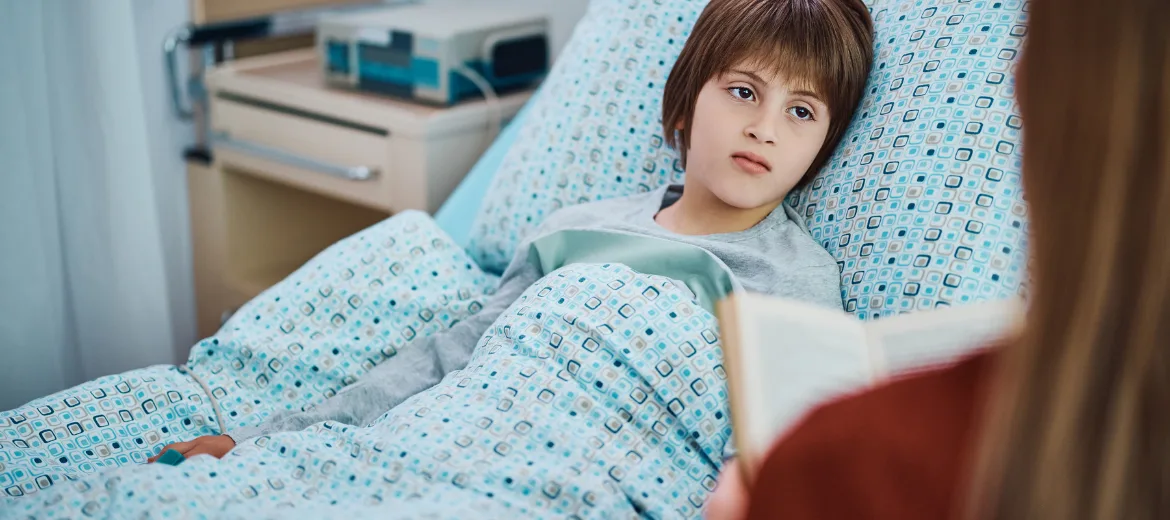
Our third child has health issues and is fed via a feeding tube. The tube in her nose has long since become part of our daily routine. Her siblings have also found their own special ways of coping with the situation: they often put a straw up their own noses to show their sister that she's not alone. It's these little gestures that touch me – without the need for grand words.
I felt a surge of anger inside. Not because of the question itself, but because of the matter-of-fact way in which it was asked.
To outsiders, the little tube is something new that inevitably raises questions. It's not as though I tell strangers about my illness – and yet it automatically becomes a topic of conversation. When I'm out and about, the same situations keep cropping up: people stop, stare and ask questions.
«Oxygen or food?»
The other day at the playground, a woman suddenly stopped right next to us. Her gaze wandered from the 70-centimetre-long tube to me and back again. Instead of saying «Hello», she blurted out: «Is that oxygen or food?»
I felt a surge of anger inside . Not because of the question itself, but because of the matter-of-fact way it was asked – as if she were simply entitled to a part of our story. My reply, that my daughter's health was none of a stranger's business, was ignored. «So what is it, then?» she asked. I said «food» and pushed the pram on.
A long road to a diagnosis
At first, we were even more grateful for the interest shown in her, especially as we were asking ourselves similar questions: «Will she ever be able to eat on her own?», «Why is that tube essential for her survival?», «What other limitations does she have?» – and above all: «What is the name of the condition behind it?»
The problem with a genetic condition is that it can take a very long time to reach a diagnosis. Consequently, even if we had wanted to, we were unable to answer these questions ourselves. We felt understood and, at the same time, taken aback. Nine months after the feeding tube was inserted, that initial sense of inner tension has given way.
Perhaps genetic diseases affect us so deeply precisely because they do not fit in with our idealised notion of «having everything under control».
There's been a growing number of comments that aren't meant to be hurtful, but still stick in the mind. When a mother I didn't know said to me as she walked past that tube feeding at least spares you the evening meal debate, I was momentarily taken aback. Of course, we see many little things in everyday life in a positive light, but I couldn't see the appeal of that viewpoint for the life of me. In moments like that, I don't see genuine interest, but rather a lack of tact.
Visibly different
I asked myself: why isn't being different really accepted? This isn't just evident when it comes to illness, but in the little things too. As soon as you look different from the norm, you get strange looks at the very least. I've already experienced this during my son's «glitter phase», when his nursery friends kept making uncomprehending comments.
My friend, who has identical twins, is going through something similar. She's regularly asked whether the children were born prematurely or if there were any complications. When people keep asking if they're twins, she now replies: «No, that's his stunt double.»
Don't rate and comment on everything
There is certainly no malice behind these many reactions. They stem from a need to make sense of things, to understand – or from a sense of helplessness. At the same time, they can cross boundaries. Perhaps genetic diseases affect us so deeply precisely because they do not fit into our idealised notion of «having everything under control».
Words of sympathy are often spoken too hastily and without thought – as my daughter's former doctor once put it rather awkwardly: «She'll manage to undo her button eventually.» Well-meaning, yet wide of the mark.
Our daughter shouldn't define herself by what others see and say, but by what makes her who she is.
Perhaps change begins precisely there: when we realise that our first instinct isn't always the best one. That we don't have to understand everything, judge everything or comment on everything. In our daily lives, this means constantly weighing things up: what do I want to share? And when should I simply leave a question unanswered?
For us as a family, our focus has shifted – away from other people's reactions, and towards what really matters. For our daughter, the feeding tube is not a symbol, but part of her everyday life. That is probably the crucial point: that she is learning not to define herself by what others see and say, but by what makes her who she is. Because being different stands out. But it says little about who someone really is.