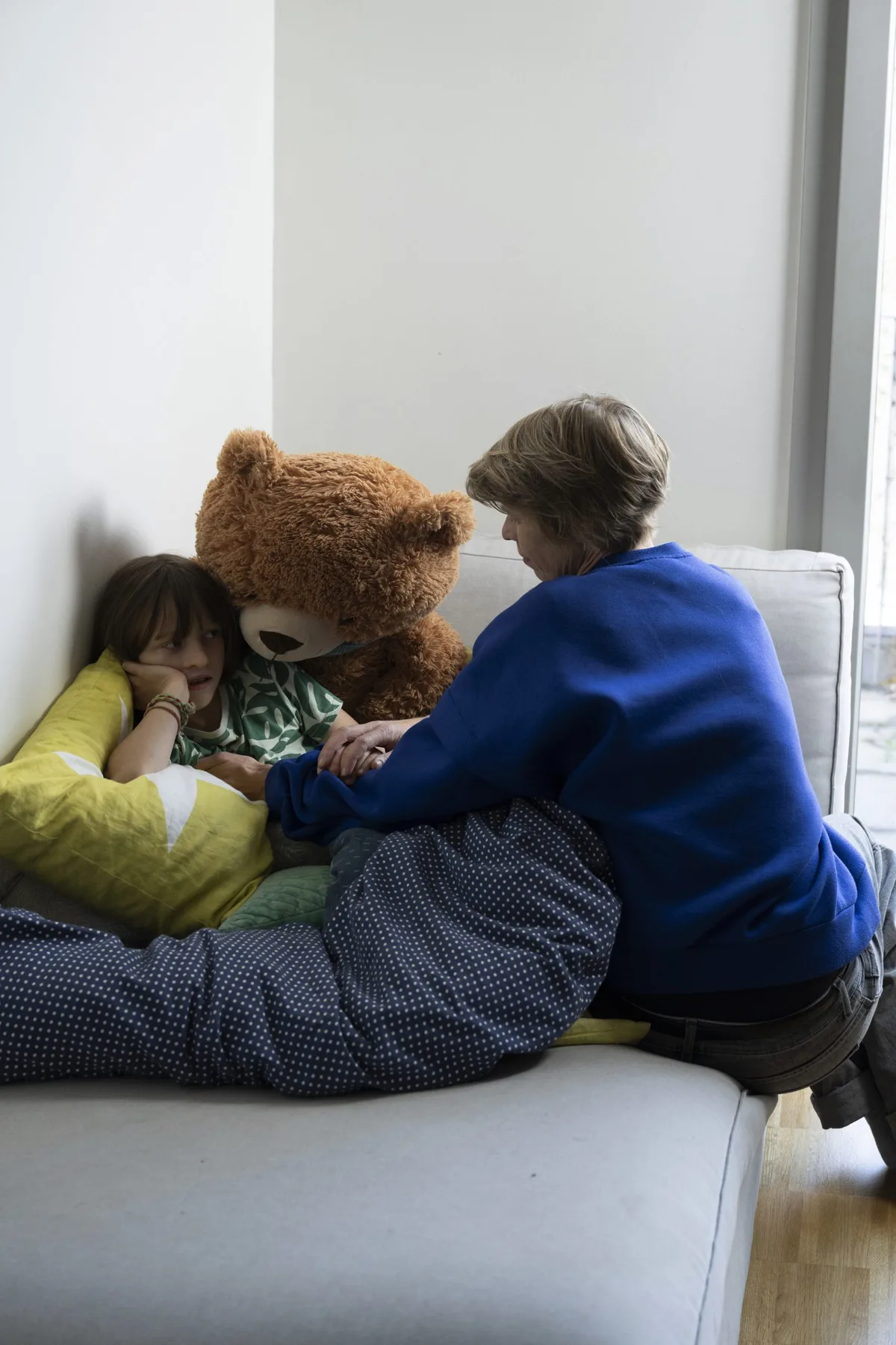
A llama hums, a drawn-out note – perhaps a G – beautifully in time, with every fourth step. After a while, a soft voice joins in a fifth higher: «I hear a little bell ringing so sweetly (…)». The voice belongs to nine-year-old Emilio. He shows no interest in the animals, which today are wandering round the garden of the Zollikofen School for the Blind instead of being out on the alp. Nor is he interested in the llama by his side. Without even looking at it, he walks alongside it and sings. The harmonious duet is astonishing – especially the way Emilio hits every note and every word so precisely. This same boy is usually quiet. Or he repeats the same three or four words over and over.
Emilio has autism. He is one of up to 80,000 people in Switzerland with the condition. There are no precise figures available in this country. However, according to international estimates, around one per cent of the population is affected by autism, and this also applies to Switzerland, as Ronnie Gundelfinger explains. He is a senior consultant at the Clinic for Child and Adolescent Psychiatry and Psychotherapy in Zurich.
The number of diagnoses has risen sharply in recent decades. Whilst in the 1970s around 5 in 10,000 people were diagnosed, the figure is now a good 20 times higher. Various reasons are put forward for this rise: better diagnostic tools, the introduction of the diagnosis of Asperger's syndrome in the 1990s, and greater awareness amongst professionals and parents, for example.
So what exactly is autism? And what is everyday life like for autistic children and their parents?
People with autism perceive the world differently. All their senses are constantly on high alert, and they are unable to filter out unimportant stimuli.
Autism: A diverse spectrum
Autism is many things. For some, it is a disorder; for others, a way of being; and for others still, a passing trend. Medically speaking, it is a predominantly genetically caused developmental disorder characterised by impaired social communication and interaction, as well as repetitive behaviour patterns and restricted interests.
People with autism perceive the world differently from «neurotypical» (non-autistic) people. All their senses are on high alert – and, depending on the severity of their condition, they are unable to filter out unimportant stimuli or shift their focus from the details to the bigger picture. This can cause such severe stress that they shut themselves off from the outside world.
Autism can manifest itself in ways as stereotypical as the character in the film *Rain Man*, who can memorise an entire telephone directory in a matter of minutes. Or it can be a single symptom, as the psychiatrist Eugen Bleuler attributed to schizophrenia in 1911: a state of being withdrawn into oneself and turned away from the world.
Even if we set aside Bleuler's view and confine ourselves to the developmental disorder in children as described from 1943 onwards by the doctors Leo Kanner (early childhood autism) and Hans Asperger (Asperger's syndrome), autism encompasses a spectrum with as many manifestations as there are autistic people. This is one of the reasons why the term «autism spectrum disorder» (ASD), introduced in the Anglo-Saxon classification system DSM-5, is becoming increasingly established in Switzerland.
Coloured socks and washing machines
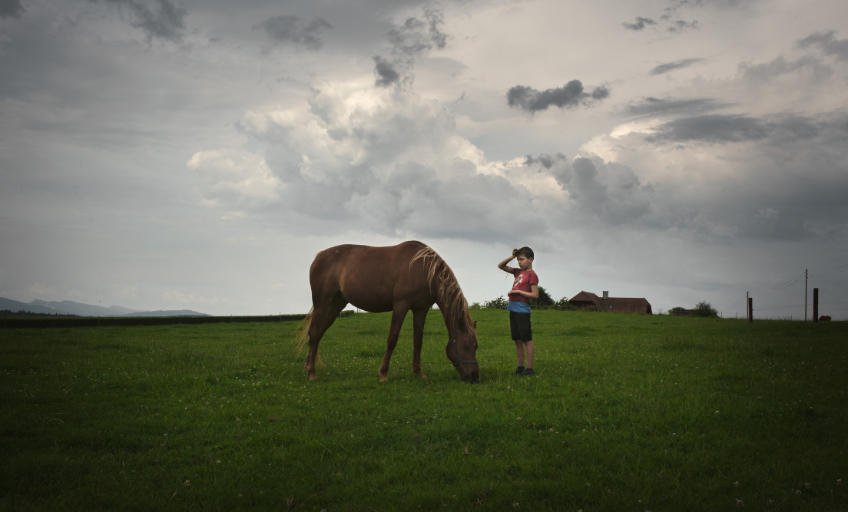
Emilio is at the «severe end» of this spectrum. He has early-onset autism. At first glance, strangers see a normal 9-year-old: a pretty child with light brown curls. He seems a little dreamy when he strolls across the meadow, examining every little twig in detail. He comes across as conscientious when he walks back along the path to close a garden gate that's been left open, and cheeky when he points out to strangers that they're wearing two different-coloured socks and insists they rectify this mistake. By the time he's lying on the floor screaming because his sense of order has been thrown into disarray, it becomes clear: Emilio is different. He has a profound behavioural and perceptual disorder.
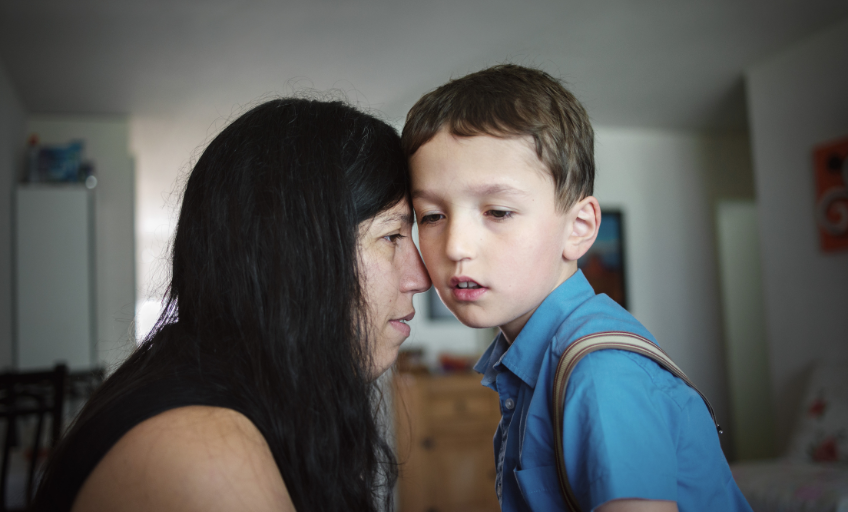
Among other things, his language development and self-motivation are limited. He requires round-the-clock care. At night, he keeps his mother, Bruna Rausa, awake; during the day, he keeps several carers on their toes (read Emilio's mother's account here: «My child is autistic»). Even as a baby, Emilio showed signs of being different, as his mother explains: «He would stiffen up when someone picked him up and wouldn't look people in the face.» Eye contact is one of the clearest signs of ASD. «Research with autistic children has shown that they often find geometric shapes on a screen more interesting than people,» says autism expert Ronnie Gundelfinger.

At first, Emilio was fascinated by the wheels of the pram. Nowadays, it's washing machines. Whilst other children stream out into the playground, he scurries into the laundry room and watches the spinning drums. Sometimes, as he does so, he repeats – almost as if singing – the same words over and over, which he picked up somewhere minutes, hours or days earlier: «Does anyone like me? Does anyone like me?»
Asperger's – the silent majority
Not everyone is as severely affected as Emilio. Children with Asperger's syndrome are generally less restricted in terms of language and cognition. However, social communication difficulties are still a major issue for them too, as psychologist Matthias Huber knows. He has Asperger's syndrome himself. More specialists are needed to act as intermediaries and interpreters. (Read the interview with Matthias Huber here.)
Translating is part of Silvia Mangold's* daily routine. She is sitting at the breakfast table with her husband and four of their seven children. The two youngest – Flurin* and Svea* – are chatting about the day ahead at school. Fourteen-year-old Fabian* retreats to his room without saying a word. «Having visitors disrupts the usual routine. That unsettles him,» explains Silvia Mangold. Fabian has been diagnosed with Asperger's syndrome. So has his 12-year-old sister Lia*. She spreads butter on her bread – seemingly uninvolved, yet alert: when the conversation turns to flying drones, she joins in.
Genetics play a part
Lia shares her passion for technology and computers with her father, André Mangold*. He is a software architect and developer. As he talks about digital transformation and sensors whilst tucking into sausages and scrambled eggs, it occurs to me that he, too, might have Asperger's.
It stands to reason, because according to Ronnie Gundelfinger, genetics play the main role in autism, alongside any environmental influences during pregnancy. «I didn't get it checked out,» says André Mangold, «but that's probably the case.» His wife has no doubt about it: he's not very good at expressing his feelings. «He's part of the silent majority.»
The school refuses to
Lia, too, hides her feelings behind a mask-like expression. Silvia Mangold taught her to read. «When she's not feeling well, she slowly slides under the table.» As a girl, Lia belongs to the minority among autistic children. «Boys are more prone to developmental disorders and are therefore more frequently affected by autism,» says Ronnie Gundelfinger. «With girls, however, the diagnosis is sometimes missed or made too late. They are less conspicuous and try harder to fit in.»
This is true of Lia. Her parents turned a blind eye to her quirks: for instance, Lia didn't like having her hair done, or she insisted on wearing just a few familiar items of clothing – even if they were worn out. It was only when she moved up to secondary school that the problems became apparent: Lia increasingly refused to go to school, until, at the age of 11, she stopped going altogether. An assessment confirmed her parents’ suspicions.
Everyday life with autism is full of challenges
It was a difficult time for Silvia and André Mangold. Their parenting methods were called into question. If they refused therapy, they were seen as uncooperative parents. Alongside bullying, arguments and sleepless nights, round-table discussions, lengthy therapy sessions and financial concerns were part of the family's daily life.
Whilst the canton and local authorities provide financial support for educational matters and the IV for medical ones, it takes a great deal of perseverance to get there, as Silvia Beispiel's case shows: she submitted an application to the IV on behalf of Fabian and Lia for the costs of their medical treatment to be covered. As required by the IV, she was able to prove that there were signs of ASD, documented by a doctor, up until the children reached the age of five. The applications were nevertheless rejected. Silvia lodged an appeal. She was successful, but it took a huge toll on her. «We were just barely coping.» Even today, the family is still just barely coping – often in a positive sense.
The walk to school is a challenge. A little Coke lid on the ground, an open garden gate – Emilio wants to sort things out straight away.
A detailed daily schedule hangs above the table. «The children know exactly what to expect,» says Silvia. If she needs support, she contacts the Nathalie Foundation's counselling centre in Gümligen, Bern. It was also the Foundation that, in collaboration with the Bern Child and Adolescent Psychiatric Service, assessed Lia for autism.
Silvia will soon be glad to have some advice again. For Fabian, the topic of vocational training is drawing nearer. Like many other parents, Silvia has a certain amount of apprehension about this. Too few trainers and employers are aware of the skills that people with autism possess. These skills are not limited to, but are often found in, the technical field. This has not gone unnoticed by IT service providers. In Zurich, and now also in Bern, the «Informatik für Autisten» Foundation offers vocational training in the IT sector.
In Bern, the Autismuslink Foundation also works to promote vocational integration, as does the Bern University of Teacher Education with its Supported Vocational Training Service (SUB). Young people and adults with ASD, for example, receive coaching arranged through the IV. Nevertheless: «Those affected and their families feel they do not receive enough support. “The services on offer do not meet the needs,» says Fabienne Serna from the «autismus deutsche schweiz» advice centre . The organisation supports and connects parents of autistic children, people with autism themselves and professionals. «There is a lack of autism-specific services and jobs.»
An interest-based curriculum
Silvia doesn't want to think about that just yet. «How are Lia and Fabian supposed to find an apprenticeship? We recognise our children's potential. But they don't have any school reports to show for it.» They haven't been to school for a year. Lia only leaves the house now if she's accompanied by her parents. Silvia is now teaching her children herself. In addition, the mobile school comes to the house two mornings a week for two lessons each time.
The programme offered by the Zollikofen School for the Blind is called «Homeschooling ». «If, despite receiving learning support, children can no longer be integrated into mainstream schools, a special needs teacher continues their schooling at home with the aim of helping them transition to a setting in a mainstream or special school,» explains Christian Niederhauser, Director of the Foundation for Blind and Visually Impaired Children and Young People. From this summer, the School for the Blind will also be offering, on behalf of the canton, a learning environment for six autistic children who are not blind: they will work in groups to foster their sense of community. At the same time, there is the option to work with the children individually in a separate room.
In addition to the Zollikofen School for the Blind, an increasing number of schools across Switzerland are developing autism-specific programmes. In doing so, they are responding to actual needs, as Andreas Eckert, a professor at the Intercantonal University of Special Education in Zurich, has demonstrated in several studies. Children with early-onset autism require more places in autism-specific facilities. Children with Asperger's syndrome, on the other hand, would benefit from inclusive education.
Whether in mainstream or special schools, working with autistic children presents a challenge. «Learn to let go,» Christian Niederhauser advises his staff. «The trick is for the teacher not to feel obliged to pursue an educational goal that is unachievable, but rather to start where the child shows an interest.»
Psychotherapy instead of swimming with dolphins
A glance into Emilio's classroom makes his interest clear: he is lying on a beanbag. «Seven round pigs, lying side by side in the hay. They're grunting, they're munching …», a song rings out from the loudspeakers. Emilio's attention spans are short, says his teacher Melanie Radalewski. The psychologist teaches Emilio one-to-one in the mornings. During the breaks between songs, Emilio recharges his batteries for the next learning session. Today he's focused: following his teacher's instructions, he writes the word «Sonne» on the blackboard, letter by letter. He owes this ability partly to intensive therapy: he receives three sessions of behavioural therapy, each lasting three hours, every week.
Finding the right treatment is a challenge. The options range from psychotherapy and special diets to dolphin therapy and medication. Ronnie Gundelfinger isn't convinced by swimming with dolphins. Nor, he says, is there a miracle cure. «Medication is used to treat the accompanying symptoms.»
For example, many autistic children would display symptoms of ADHD and benefit from Ritalin. For the expert, however, one thing is clear: «The only approaches known to date to be effective are therapy programmes developed specifically for autism. Behavioural therapy programmes have been the most thoroughly researched. Early intervention and a high intensity of treatment play a crucial role in this.»
Certain aspects of autism spectrum disorder can be treated through occupational therapy or speech and language therapy. In addition, many special educational schools in Switzerland use the TEACCH method (Treatment and Education for Autistic and related Communication-handicapped Children). More intensive therapies are often based on the behavioural therapy approach known as ABA (Applied Behaviour Analysis).
A dressage routine?
Emilio knows the latter well. Right now, he is sitting with his ABA therapist, Jessica Stauffacher, poring over tasks designed to develop his language, cognitive, motor and social skills. The room is dimmed. Emilio is very sensitive to light. «What do you want to work towards?» asks the psychologist. «A sweet or the shaggy bear?»
To earn his much-desired «Zoggubär» break, Emilio first has to put the cards in a picture story in the correct order. Then he sits down on the sofa and watches as the bear glides across the room, eventually landing on his tummy. Emilio throws himself into the game with enthusiasm. Then it's on to the next task. And the next reward. The whole thing is somewhat reminiscent of a dressage routine. «That's the most common criticism,» says Jessica Stauffacher. However, Emilio is responding well to this approach. «He stays seated for longer than before, solves some tasks more easily and, what's more, hardly displays any aggressive behaviour anymore.»
The earlier autism is diagnosed, the better
Emilio began his therapy at the age of four. The trend today is different: studies point to the benefits of starting therapy as early as possible. There are six early intervention centres in Switzerland – for example, the FIAS in Basel, which was established in 2010 based on the Israeli Mifne approach and accepts children aged between 1.5 and 4 years.
The blinds in the therapy room are not raised evenly. Emilio carefully rectifies the problem.
However, early intervention services are not currently accessible to all children with autism. For some parents, the burden is too great – whether due to travel or the costs involved. Whilst the IV provides a flat-rate grant of 45,000 Swiss francs for intensive treatment of early-onset autism at one of the six early intervention centres, this amount does not cover the full costs. At FIAS, for example, the three-week course of intensive treatment, including two years’ follow-up care, costs 90,000 Swiss francs.
Not enough places
Often, diagnoses for early intervention are made too late. «It's difficult to get a diagnosis before the age of four,» says Emilio's mother, Bruna Rausa. «I realised right from the start that something wasn't right with my baby. But paediatricians sometimes fail to recognise the early signs.» Emilio was finally three years old when his ASD was medically confirmed.
Ronnie Gundelfinger usually makes an autism diagnosis from the age of 2½ years. Sometimes the signs are evident even earlier. «But nobody will fund treatment for a one-year-old.» It is also questionable whether early diagnoses should be actively encouraged. «The provision of early intervention services is stagnating in Switzerland.» So there are too few places available.
- Early-onset autism, also known as Kanner's autism (named after Leo Kanner): manifests within the first three years of life, often with severely impaired language development and cognitive impairment.
- Asperger's syndrome ( named after Hans Asperger): no delay in language development, at least average intelligence, often motor skills difficulties, sometimes only recognisable in interaction with others – in primary school or later.
- Atypical autism: symptoms of early-childhood autism are incomplete or present in a mild form; it often manifests after the age of three.
As the individual subtypes are not always easy to distinguish, the term «autism spectrum disorder» (ASD) was introduced into the Anglo-American classification system DSM-5 in 2013. It is increasingly replacing the diagnoses mentioned above. ASD encompasses a continuum of disorders of varying severity – depending on how much support the child requires.
It is also specified whether there is a disorder in intellectual development and in the use of language. People with autism share difficulties in the following two areas:
- Social communication: e.g. little eye contact, little or unusual response to others, little contact with peers, lack of facial expressions and gestures and/or difficulty understanding the gestures and facial expressions of others, delayed or absent language development, or unusual use of language, e.g. repetitive use of language, neologisms, precocious speech.
- Restricted, stereotyped patterns of behaviour, interests and activities: excessively focused interests and persistent preoccupation with a particular topic (e.g. meteorological data), stereotyped actions (e.g. rocking the upper body).
The terms «high-functioning autism» and «low-functioning autism» refer to the cognitive level. Whilst low-functioning autism is associated with a below-average IQ, children with high-functioning autism have a normal to above-average IQ. This means that children may meet the criteria for early-onset autism, exhibit delayed language development and have an above-average IQ.
When we speak of autistic traits, certain characteristics of the condition are present, but they are not pronounced enough to warrant a diagnosis.
«It should be ensured that every canton has at least one centre of expertise on autism with sufficient capacity to meet demand.» This was one of the recommendations made by the Federal Council in 2015 in response to a postulate by Claude Hêche, with a view to improving the situation of children with autism and those around them. The ideas are there. Implementation takes time.
Emilio takes his time. His therapy session is over. His mother is waiting. The therapist is waiting. And Emilio? He goes back into the therapy room once more. The blinds aren't all raised to the same height. He carefully rectifies the problem, lost in his soft, sing-song voice: «I'm off now, bye. I'm off now, bye.»
*Names known to the editors