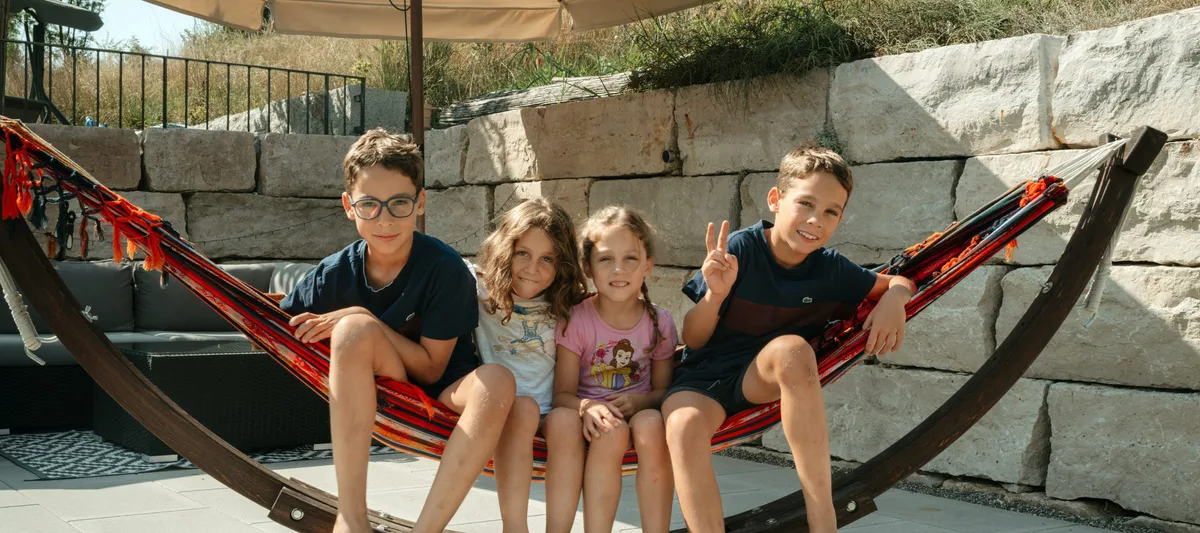
When Matthias Remund is asked if he has any children, he says: «Yes, four.» That alone amazes most people. When they then ask how old the children are, and he replies «nine and five», people are even more taken aback.
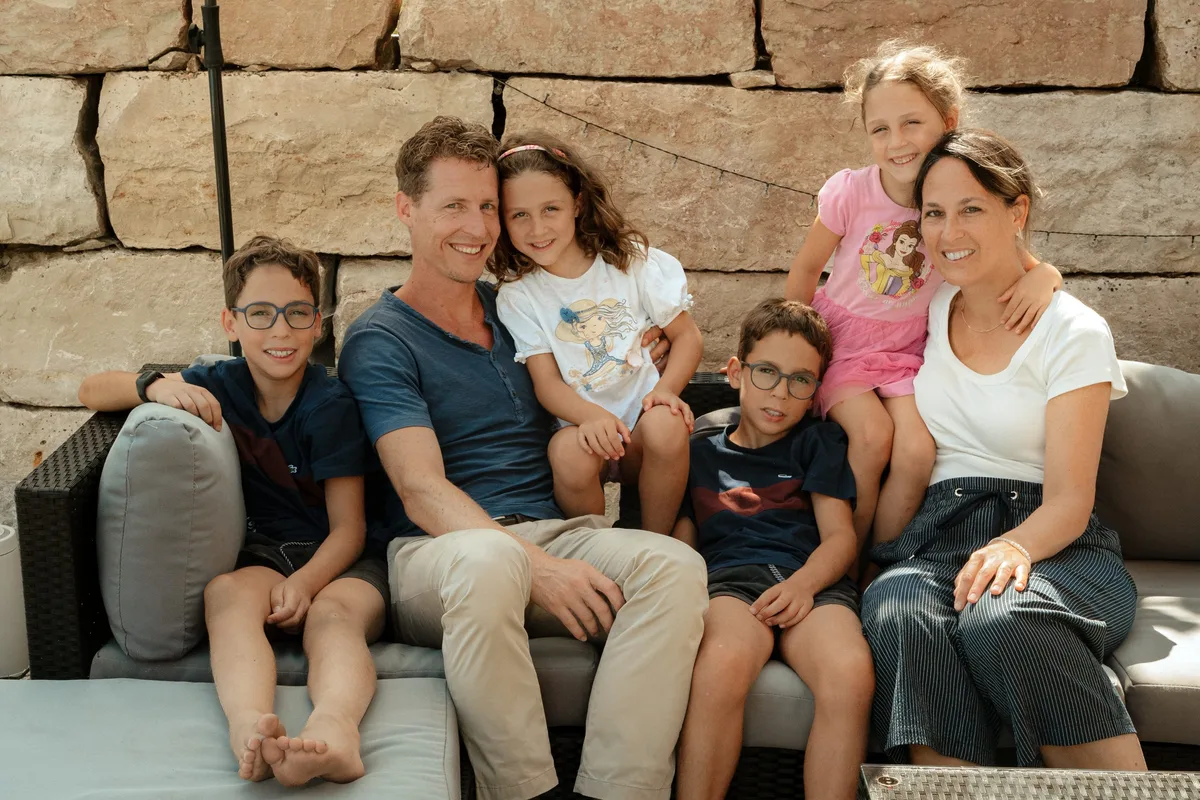
Lydia and Matthias Remund live in Villmergen in the canton of Aargau and are parents to twins. And not just once, but twice over. What's more, these twins are almost certainly identical. The probability of giving birth to identical twins twice in a row naturally is around 0.0016 per cent – that's one in 62,500 births. Although the Remunds have been active in various Facebook groups and WhatsApp chats for parents of multiples since their children were born, they have not yet met another family who also have identical twins twice.
Lukas and Marius, aged 9, and Lucy and Melina, aged 5, are an unbeatable team of four. «Of course, they do have the odd argument, but they're already a close-knit bunch. As soon as one of the children has an idea, all four of them get behind the same plan – which, depending on the idea, is either a relief or quite exhausting for us,» says their mum, Lydia.
Yet even though the two sets of twins see themselves very much as a unit, it is important for the parents to bring them up as individuals: «To us, they are four different children and we try to respond to the needs of each one,» says Matthias. «I think they see themselves as twins more than we do.» When a child wants something, it can sometimes be difficult to tell whether it's really their own need or rather their twin's wish.
Similar interests, yet not quite the same
Lucy and Melina go to the same nursery. Lukas and Marius, on the other hand, have been in separate classes right from the start – they're now in Year 4. «We decided this together with the children. As long as it works for everyone, we'll keep it that way,» says Lydia. The girls are generally closer, whether they're playing or doing things together. The boys are often apart during the day and have different hobbies, but at night in particular you can tell they need each other; they even often sleep in the same bed.
Although the boys have very similar interests, they don't actually want to do exactly the same things. Lukas has done kickboxing, is currently a member of the gymnastics club and plays the keyboard. Marius, on the other hand, does judo and athletics and plays the electric guitar. The girls don't have any regular hobbies as yet .
Although we felt a sense of joy right from the start, at the same time it came as a shock and a huge surprise.
Matthias Remund
When Lydia first fell pregnant, she and Matthias had only been a couple for a year and a half. They were both over 30 and felt that things were working out between them, so they decided to «take a chance».
At the start of their relationship, they were still toying with the idea of emigrating to South Africa. Matthias had already spent half a year studying there. They reckoned that even with a child, they could still emigrate without any problems.
Adapting to the new situation
At the first ultrasound scan in the ninth week, their plans to move abroad quickly took a back seat: «You could see straight away that there were ‹two of them› in there, not just one,» says Lydia. «We felt joy right from the start, but at the same time it was a shock and a huge surprise,» recalls her husband Matthias.
As well as the uncertainty about what life with two newborns would be like, practical concerns soon began to arise: Do we have enough space in the flat? Do we need a bigger car? Fortunately, the couple had plenty of time during the pregnancy to adjust to the new situation and get ready for it.

Marius and Lukas were eventually born by caesarean section five weeks before their due date. To this day, the two of them argue about who is older. This is because Lukas was delivered first, but if the birth had been natural, Marius would have been older, as he was already in the birth canal. The premature babies each weighed around two kilograms and had to stay in the neonatal unit for a further twelve days. After that, the four of them were finally allowed to go home to their 3.5-room flat.
«We were really lucky with the boys,» says Matthias. «Both of them were sleeping through the night by the time they were three or four months old.» Although Lydia was initially stressed that breastfeeding wasn't working out, this meant her partner was able to take over the bottle-feeding from the very start, which was a huge relief for her.
A child to cherish
After the birth of their twin boys, the couple set about looking for a house or a plot of land to build on. And here, too, they were in luck: in Villmergen, the village where they lived and where Lydia had called home for many years, they were offered a plot of land. A year later, the family of four were able to move into their new home.
They planned the house with three children in mind. «Because with twins, everything's over in a flash, we liked the idea of having a third child,» says Matthias. An uncomplicated pregnancy, a natural birth, and breastfeeding if possible – that was their plan. «We were so naive,» says Lydia.
It wasn't long after they'd moved into the house that Lydia was pregnant again. As the coronavirus pandemic was raging at the time, Matthias wasn't allowed to be present at the first ultrasound scan and had to wait in the waiting room instead. When his wife – the couple had got married in the meantime – came out of the room, she had to pop over to the reception desk to book her next appointment. So she stood there and held up just two fingers. «I knew straight away what it meant,» says the 44-year-old.
Thrown into an adventure
At first, the shock was even greater than it had been the first time round. «Can we manage this? Can we manage financially? Can we manage the care arrangements? It's always been important to me to carry on working and thus remain independent to some extent,» says Lydia. The 43-year-old is an anaesthesia nursing specialist at a large hospital.
But the two of them already knew what lay ahead and that they could rely on each other. They were already living in a house and had a big car. So they threw themselves into the adventure, as Lydia explains: «We've both always been the sort of people who just took life as it came, without making any grand plans. That's what defines us. So we said to ourselves: ‹This is just how it is, and that's the way it's meant to be, so let's just go with it.›»
Like their brothers, Melina and Lucy were also born five weeks prematurely. Lucy weighed just 1.5 kilograms at birth and had to spend a week longer than her sister in the neonatal unit – almost three weeks in total.
During the pregnancy, it had been assumed that the girls were fraternal twins because they had two amniotic sacs and two placentas. But when the two newborns turned out to look absolutely identical, people were no longer so sure. This is because, depending on the day the egg splits, even identical twins can have two placentas. The girls also had their «stork bites» in exactly the same place and, as babies and toddlers, always suffered from the same illnesses.
Warning: risk of confusion
«Even in terms of behaviour, the girls seem even more identical to me than the boys,» says Lydia, laughing. She «strongly suspects» that Melina and Lucy are also identical. The only way to be 100 per cent certain would be through a DNA test. As for the boys, there is no doubt that they are identical, as they shared a placenta.
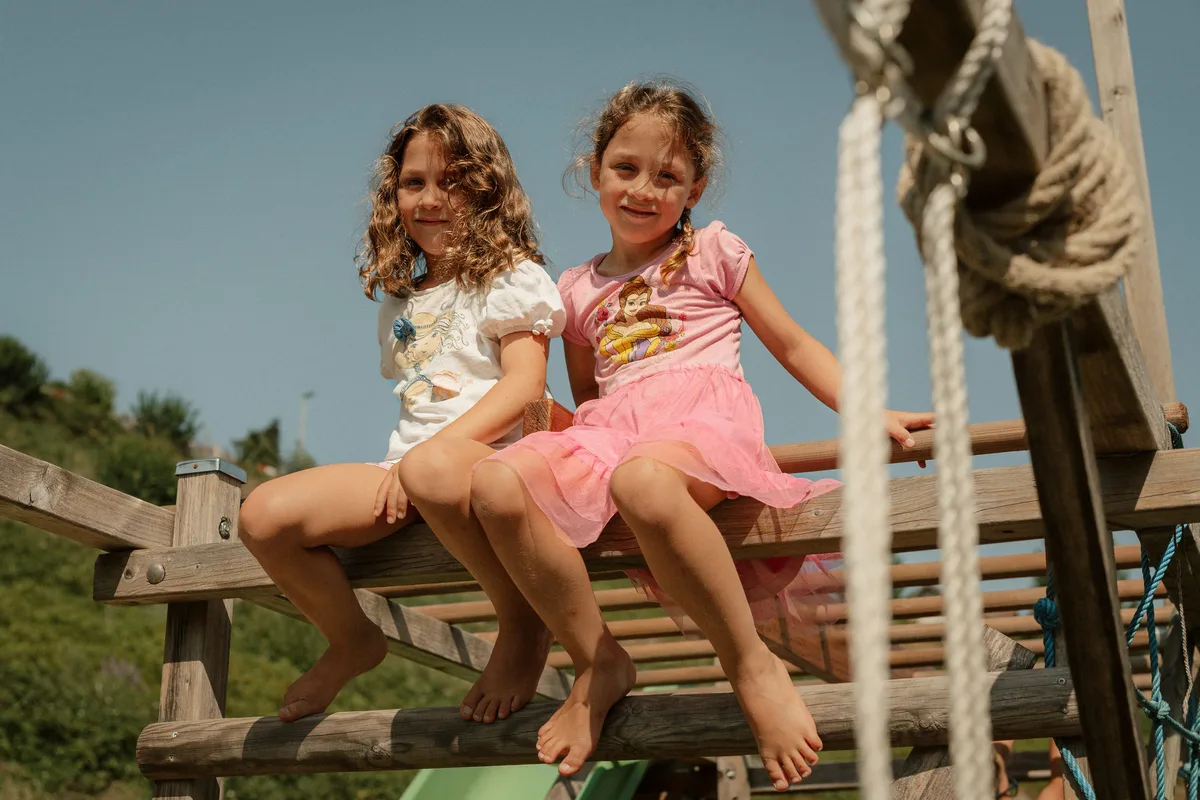
There's no doubt that the two sets of twins look very much alike. Even today, family and friends struggle to tell them apart – even those who see them every week. The girls also often deliberately wear the same clothes: «That way, the nursery teachers can't tell us apart,» says Melina with a grin.
When they were still babies, I sometimes found it hard to tell them apart myself.
Lydia Remund
The boys have also had some funny moments at school. Marius recounts that he once had to go to the loo during a lesson and bumped into one of his brother's teachers. She said to him: «Lukas, why don't you go to the loo upstairs?»
«When they were still babies, I sometimes found it hard to tell them apart myself,» admits their mother, Lydia. At the swimming pool, for example, she would deliberately dress the children in different swimming trunks so that she could always keep an eye on all four of them and wouldn't miss it if they swapped places.
Even in old photos, they sometimes find it difficult to tell the children apart. Especially when only one of the children is in the picture. «In everyday life, we recognise them by their facial expressions and gestures, their movements and their personalities. All of that is lost in a photo,» explains Matthias. That is why they started labelling photos correctly from an early stage.
To this day, they make a point of ensuring that there is always at least one thing different about the children's outfits. «So that people who want to tell them apart actually have a chance.»
No exclusive time requested
For each and every one of them, their own twin is the closest person to them and takes top priority. They share their chocolate bar with their twin. And when they have a brilliant experience, they want their twin to be there with them. «We once tried having ‹Mum and Dad days› to give them more exclusive time with us. But they didn't want that at all; they found it boring. They much preferred to share those lovely experiences with their twin,» says Lydia.
Life with two toddlers and two newborns had certainly been very tough. «But at the time, I didn't find it that intense at all, because we simply knew we had to do it and there was no other option,» says Lydia.
During the first three months, the family hired a cleaning company to help out. What's more, the grandmothers still iron and fold the washing to this day.
«What annoyed me most during that time were other people's reactions. For example, when someone would say: ‹Oh my God, twins twice over – that must be tough!›», says Lydia. When she was out and about with all four of them, she sometimes felt as though people were literally waiting for her to lose her temper and snap. Of course, she sometimes reached her limits when one child had a full nappy, the second was thirsty, the third wanted to play and the fourth needed to go to the loo. In moments like that, she would always tell herself: «You just need to take a deep breath and tackle things one at a time.»
It's all just a phase
Lydia Remund currently works 50 per cent of full-time hours and her husband Matthias works full-time. The two boys initially went to nursery, but now that their grandparents have retired, they each look after them one day a week.
Matthias finds the different phases the children go through to be the biggest challenge. «No sooner have you got used to one behaviour than the next one comes along. And then it always comes in double the amount and in different forms. I found that quite difficult, especially at the beginning.»
When the children are ill, we realise we've got nothing left in the tank. That's when I reach my limits.
Lydia Remund
Day-to-day life actually goes quite well. So much so that Lydia doesn't feel as though she's running on empty every single day. But when one of the children falls ill, it's only a matter of time: in two days’ time the next one will fall ill, and then another two days later the next one. That's when she realises she has no reserves left. Once, when the children had a stomach bug, the parents had to change the bed six times in one night. Matthias would often fall ill as well. Lydia herself has never been ill since they've had children: «I'm the one who's always on the go. And at some point, it all adds up to the point where I reach my limits.»
And how often do you find time for each other in the hectic daily life of a family with four children? «We certainly don't have quite enough of that,» says Lydia. «But it's always a question of what you need. We're not the sort of people who have to go out for a meal together once a week. We carve out little pockets of time in our family life and make time for each other. That works for us.»
They really catch the eye
For the Remunds, the best family moments are when they go on holiday or take a day out twice a year. «When we get away and just have time,» says Lydia. They don't have any rigid plans then, but take each day as it comes and organise it so that it suits everyone as much as possible. This summer, the family also bought a stand-up paddleboard, which they sometimes took out onto Lake Hallwil in the evenings. «As there's always so much to do in everyday life, we have to make a conscious effort to carve out moments like these. That makes us enjoy them all the more.»
When the six of them are out and about, people often stare at them in disbelief or they hear someone whispering behind their backs, says Matthias. It then takes them a moment to realise what people find so special. «Because we don't really see them as twins any more. To us, they're just four different children.» His wife Lydia feels the same way. Because she doesn't notice it herself any more, she sometimes asks her sister, with a touch of disbelief: «Do they really look that much alike?»