

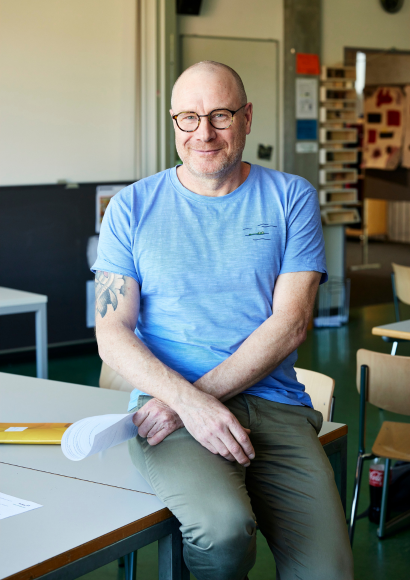
«Is this some sort of psychotherapy?» When Patrick Schmitt, a teacher at the Educational Centre for Technology (BZT) in Frauenfeld, welcomes new pupils, they are often surprised, and more often than not, unsettled or sceptical: happiness as a school subject – can that really work? Can positive feelings be learnt like the multiplication tables, and in a place where they are often neglected, of all places?
The BZT is one of the first schools in Switzerland to have included happiness in its timetable. As part of the bridging programme for young people who have not yet found a path forward after completing compulsory schooling, Schmitt has been teaching «Happiness & Resilience» since 2021.
Building self-esteem and teamwork skills
«Happiness on its own is a rather abstract concept that we interpret in different ways,» says Schmitt. «Moreover, this isn't just about feeling good. Rather, young people should develop tools that help them take control of their own lives.» This is where resilience comes into play – that inner strength which allows us to maintain our confidence, or to rediscover it, even when happiness throws a spanner in the works.
Over the course of the 72 lessons with Schmitt, young people are given the opportunity to practise skills that researchers consider crucial to our long-term mental wellbeing. According to Schmitt, these include self-regulation and the ability to work in a team, and, in particular, an awareness of one's own strengths and values: «Who am I? What is important to me? How and where can I make the most of what sets me apart?»
Young people explore questions like these in Schmitt's happiness lessons, in a wide variety of settings – ranging from reflective activities and group work to practical exercises and creative projects.
Issues that directly affect young people
Whilst the first semester focuses primarily on raising awareness of one's own strengths and values, the second half of the year covers topics such as gratitude, decision-making, procrastination – the constant putting off of tasks – and dealing with difficult emotions and change.
Happiness as a school subject is not an end in itself – it must be evidence-based if it is to genuinely benefit young people.
Patrick Schmitt, teacher
«Wherever possible, I link my lessons to topics that directly affect young people,» says Schmitt. «That's the only way to ensure they can apply what they've learnt to their own everyday lives.» In his lessons, Schmitt draws on a wide range of methods from happiness and resilience research, positive psychology and personality development. He also draws on his own long-standing experience as a trained health clown, supporting those who are ill or dying.
Schmitt is convinced that if happiness is to be taught in schools, it should not be treated as just another feel-good activity: «Happiness as a school subject is not an end in itself – it must be evidence-based so that it actually benefits young people.»


