

Two reluctant singers come into their own in music lessons
Passionata – Music lessons make all the difference
One day, three boys came running towards me in the playground. One of them was Linus* from Year 6, a former pupil of mine. He called out: «Miss Dubs, isn't it true that I was good at music?» «Oh yes!» I confirmed, «You were my head choreographer.»
At the start of Year 1, Linus showed little enthusiasm for music lessons; instead, he seemed decidedly listless. Whether it was singing, playing music or dancing – nothing seemed to get him out of his shell. That changed when the children were set the task of drawing a dance formation from a bird's-eye view.
Music engages all the senses. It doesn't just stimulate one specific area, but the whole person.
Reflections in the form of drawings, notations or keywords are an important part of music lessons. They help us to communicate about music and movement. Sketches allow us to grasp things visually. This is particularly helpful for people who struggle with body awareness.
Linus takes the reins
Even at the age of six, Linus possessed an extraordinary sense of spatial awareness and was able to put his ideas down on paper. Before long, he was unstoppable, directing the children to their places according to his drawings. The most wonderful choreographic ideas came to him effortlessly, and he had no doubt that his plans were spot on.
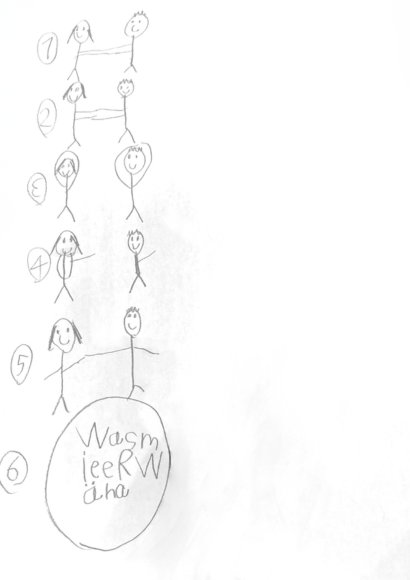
He moved his classmates around the room like pawns and even took control of the whiteboard, which was clearly my territory in the music room. But Linus drew without asking, using different colours, arrows and even little captions to make it clear who should stand where. The fact that Linus often wore a black turtleneck jumper, making him look a bit like a mini-choreographer from the opera house, rounded off the situation. Some roles are simply predestined.
Linus drew up formations for our class music sessions, little improvised theatre pieces and, above all, for our dances. It wasn't just a matter of statically assigning places. He also helped to design the movements. And because words and drawings were no longer enough for this, I was able to watch with delight as Linus began to demonstrate his ideas through dance. In doing so, he combined his sense of aesthetics and spatial awareness with our sixth sense: proprioception.
The perception of one's own body in space
This refers to our awareness of our own body in space and plays a key role in enabling us to maintain our balance, walk upright and move with precision. Thousands of sensory receptors located around our muscles send information to the brain for this purpose. Until now, Linus had not appeared to be particularly skilled at movement, but his reflections and ideas on paper ultimately led to a noticeable improvement in his body awareness.
This is precisely what elementary music education means by holistic development. When a child's talent is brought to the fore, they become intrinsically motivated to improve their skills. Because music engages all the senses, this approach nurtures not just one isolated area, but the whole person.
Singing is like playing football inside your own body. You're controlling the tiniest muscles, tendons and joints in here.
For a long time, I couldn't find a way to connect with Diego*, another former pupil. He hardly ever took part in lessons, was often lying on the floor, and would occasionally cause a disturbance. His form teacher told me that things were much the same in the classroom. In cases like this, building a relationship outside school can help. After all, problems can be resolved when you get to know someone in a new context.
Diego, the King of Proprioception
A classmate told me that Diego was the best footballer in his year group. I was surprised, so I went to the football pitch during break time to watch him. His ball control, his timing and his awareness of the pitch made it clear to me: the lad was a master of proprioception.
Diego sensed that I had a new perspective on him since attending the match. This gave our relationship a fresh start. More importantly, I made it clear to Diego that he could also make a name for himself in music with his talents. «Singing is like football within your own body,» I explained to him. «You're controlling the tiniest muscles, tendons and joints in here.»
I pointed to my larynx. All the children touched their necks, and we hummed melodies up and down the scale, feeling how the intensity of the vibrations changed depending on the pitch. We crossed our arms and, with our eyes closed, felt how far our ribcages expanded as we breathed in. It was the first time Diego had taken part in warming up his voice and body.
A week later, when we were singing, he chose the spot right next to my piano stool. He, who would normally disappear behind the piano after the very first song, was now standing there on both feet like a model choirboy. And when a girl proudly announced that she had practised the whole lyrics of the «Earthworm» song and now knew it off by heart, Diego went one better in the next lesson by saying he'd been practising singing over the weekend and asked if he could sing a solo. He had actually learnt the whole song. And so Diego went from playing football to singing, and Linus from drawing to dancing.
Fond memories
When I asked Linus, who had grown quite tall by then, that afternoon in the playground whether he remembered the firefly dance he'd choreographed in Year 2, he grinned smugly. With elegant steps, he demonstrated how he'd performed back then with the first four children from the left in the semi-darkness, holding LED candles which he swung upwards.
«Those were the days,» said Linus, as if he were looking back on his career at the age of 70. Then he pulled his jumper sleeves back into place and, without a word, held out his hand to me in farewell. The other two lads followed his lead and even mimicked his subtle nod. It was the perfect choreography for a farewell.
*The children's names have been changed by the editors.
Passionata – Music lessons make all the difference
From Year 3 onwards, they have the opportunity to join the school choir. Children and teachers regularly sing and dance together in the playground.
Making music is life itself, and pedagogically sound music lessons are vital for every child's development.


