

It sucks and spits. How it tickles!
Sssssuuuuuuuumm, it buzzes past the ear of someone just drifting off into a deep sleep, and again: sssssuuuuuuumm. The person is instantly awake and sets off on a furious hunt: if a mosquito dares to enter the bedroom, it is usually its death sentence.
The relationship between humans and mosquitoes can, at best, be described as tense. For centuries and across all continents, these slender insects have been one thing above all else to humans: a nuisance. This is not only due to their insistent buzzing, but rather to the damage they cause. Their bite leaves itchy welts; in the worst case, they inject us with a pathogen.
There are around 45 families of mosquitoes. However, only three of them are blood-sucking and thus potential disease carriers: mosquitoes, midges and black flies. Plus the sand fly, the only species of the sand fly family that enjoys a sip of fresh blood. Humans are not the only victims of these biting insects; cattle and pigs, horses and dogs are also plagued by them. «Most midges are opportunistic,» says Alexander Mathis from the Vetsuisse Faculty at the University of Zurich, «they bite whatever comes their way.» Only species of biting midges not found here, such as the yellow fever midge or the malaria-carrying Anopheles midge, favour humans as blood donors.
The same goes for all mosquitoes: the females are the nasty ones. The males are vegetarians.
Mosquitoes dry out very quickly; their body structure gives them a relatively large surface area for evaporation. This is why they are most active at dusk, particularly near bodies of water and in warm, humid weather conditions. As mosquito larvae can only develop in stagnant water, they lay their eggs near lakes, puddles and marshes. After one to three days, a larva hatches from the millimetre-sized eggs. After a further four to five days, it pupates and a few hours later the adult mosquito emerges. Their lives are also short: these bloodsuckers usually live for only a few weeks, largely due to external circumstances. In other words: too much sun or people who react too quickly.
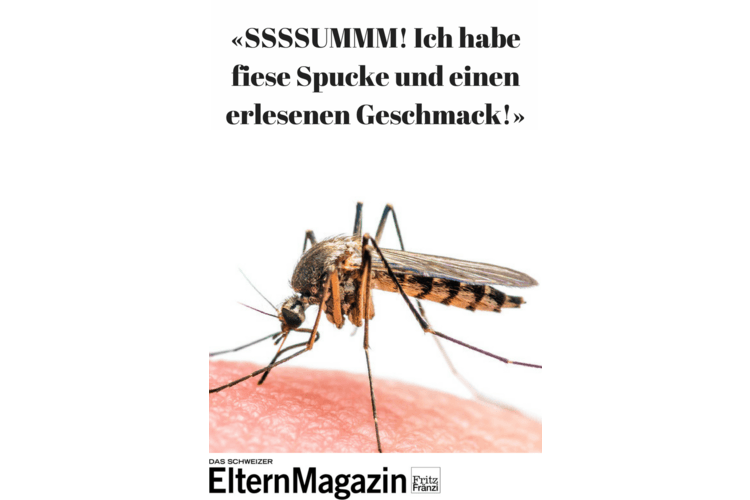
The family that by far visits us most frequently are the mosquitoes. There are more than 3,500 species worldwide, with just over 100 known in Central Europe. One thing applies to all of them: it's the females who are the nasty ones. The males serve only to mate and are completely harmless. They spend their days lapping up nectar and honeydew, or drinking the sap from plants which they pierce with their proboscis. Whilst the males remain vegetarians throughout their short lives, the females occasionally abandon this diet. One can only approve of the reason for this: they need nutrients for their offspring.
Iron and proteins from the stolen blood ensure that the eggs can develop after fertilisation. The caring mother draws two to eight millionths of a litre of blood from us per bite; that is bearable. It is not the blood loss that causes us pain, but the mosquito's saliva. When the greedy female bites, she injects saliva into the victim via her proboscis. Why does the mosquito do this? A substance in the saliva prevents the blood from clotting in the proboscis as it is sucked out, which would otherwise block it. The human body identifies the saliva as a foreign body and immediately begins to fight it off: it itches and burns. This is unpleasant, but nothing more. «Genuine allergic reactions to mosquito bites are extremely rare,» says parasitologist Mathis.
Feeling unwell after a mosquito bite? In our part of the world, that's highly unlikely.
Far more feared than a few itchy bites are the diseases that can be transmitted by mosquito bites: yellow fever, Zika, dengue and chikungunya fever, malaria, West Nile fever, Sindbis fever – the list goes on. And yet, in our latitudes, there is no cause for concern. For an infection with a pathogen to actually occur, several conditions must be met: first, the mosquito must bite someone who is carrying the disease. It ingests the pathogen along with the blood. The pathogen multiplies within the mosquito's body and spreads from the gut to other parts of the body – provided the external conditions are right: it must be consistently warm enough and the mosquito must live long enough.
Once the mosquito is indeed teeming with the pathogen, it must bite again to transmit the disease to humans via its saliva. «Even in highly endemic areas, usually only one per cent of mosquitoes carry the pathogen,» says Alexander Mathis. The likelihood of becoming infected from the few mosquito bites one might receive in this country is therefore extremely low. Even the Asian tiger mosquito, which has migrated from southern Europe in recent years and is now widespread mainly in Ticino – and which is currently causing some concern – poses no danger. The populations are far too small, and the often cool climatic conditions make survival difficult for them.
Who the mosquito particularly likes to bite...
But why do mosquitoes target us in the first place? It is undisputed that not every person is equally attractive to these creatures, as confirmed by Zurich-based mosquito researcher Mathis. However, science only partially understands the reasons behind this. One important attractant is the carbon dioxide found in human breath. Other attractants include heat and specific odours on the skin. Although mosquitoes are also drawn to contrasts in brightness, completely darkening the bedroom does not necessarily guarantee success: as body odour is the primary factor, a bloodthirsty mosquito will find its way even in the dark. Female mosquitoes can detect human odours from a distance of up to 70 metres. «The different composition of the bacteria that help break down sweat creates a unique body odour,» says Mathis. Every species of mosquito has its preferences; some appreciate a strong lactic acid scent, whilst others are drawn to a high ammonia content.
Scientists have now dismissed smelly feet, high blood cholesterol levels or certain dietary habits as factors that attract mosquitoes, relegating them to the realm of myth. Nor are women bitten more frequently than men. However, recent research suggests that metabolic products in the blood do indeed play a role. There are likely differences between blood groups, and pregnant women are actually bitten more often. Another group that is particularly popular with female mosquitoes remains a mystery to scientists to this day: anyone who drinks beer and then goes to sleep significantly increases their chances of getting a few bites.
And anyone who's immune to the stings...
Some people are bitten by mosquitoes but don't even notice. «They don't get any welts, it doesn't itch; they've become tolerant to mosquito saliva, probably because they were bitten frequently as children, for example,» says Alexander Mathis. Such people then think they've been spared. In reality, they simply don't feel the bite. In fact, nobody actually feels it; the mosquito's proboscis is as fine as a hair. What we interpret as the pain of the bite is the body's immediate alarm reaction.
It bites to ensure its survival. It spits out saliva so that its proboscis does not become blocked. We put up with all that. But why this unspeakable buzzing and whirring? That is pure physics. When the mosquito flaps its wings, the muscles in its thorax contract and relax again. All this happens at breakneck speed, causing the surrounding air to vibrate. This creates the buzzing sound, which, incidentally, is not only intended to keep us awake: mosquitoes recognise each other by it. Males buzz at a frequency of around 600 hertz; females flap their wings slightly more slowly, reaching only 550 hertz, so their buzz is lower. The male mosquito finds this sexy. We, not so much. As soon as a buzzing, whirring sound rips us from our dreams, it therefore means «danger!» for the mosquito.
Image: Fotolia
This protects against mosquito bites
- The most effective protection against mosquito bites is clothing.
- Exposed skin is best treated with so-called repellents. These are active ingredients that deter the parasites through their scent, but do not kill them. The two best-known repellents are DEET and Icaridin. These synthetic substances keep mosquitoes at bay for four to five hours, but can also irritate mucous membranes and eyes. DEET is also suspected of causing nerve damage under certain conditions; research into this is ongoing.
- An effective plant-based repellent is PMD, also known as citriodiol. It also provides protection for several hours.
- Effective, but not very practical: lavender oil, coconut oil and other essential oils. Their protective effect lasts only ten minutes; after that, they evaporate and need to be reapplied.
- It doesn't matter what you use: you should apply something to every exposed patch of skin, because mosquitoes are relentless.
- As the body's natural odour attracts mosquitoes, it helps to wash frequently. If you take a cold shower in the evening and then sit out on the balcony, you'll have some peace and quiet for a while, until your body odour and body heat return to levels that attract mosquitoes.
- Home remedies such as eating garlic, taking vitamin B tablets, or placing tomatoes, basil plants and a lemon studded with cloves in the bedroom have so far not stood up to scientific scrutiny.
This helps with mosquito bites:
- Don't scratch! Scratching increases blood flow to the affected area, spreads the mosquito saliva that causes the itching, and makes the discomfort even worse. What's more, scratching carries the risk of dirt or bacteria entering the bite site and causing an infection.
- To relieve the itching , apply ice cubes, cooling pads or cold flannels from time to time .
- If children simply cannot stop scratching, a cooling gel containing cortisone can also be applied to prevent the wound from becoming infected. This soothes the itching even more effectively.
- Heat is just as effective as cold: applying a local heat shock directly to the bite site ensures that the anticoagulant proteins injected with the saliva are rendered harmless. Small heat pads designed for this purpose are available in shops; these heat up to just over 50 degrees Celsius. The same effect can be achieved using a coin, which you heat over a lighter or a candle until it is just hot enough to touch. The heat shock is most effective immediately after the sting, as the venom is then still concentrated close to the surface.
The most dangerous animal in the world
There is only one animal more deadly to humans than humans themselves: the mosquito. More than 700,000 people die every year from a disease transmitted by these insects. The latest estimates even suggest up to 1.2 million malaria deaths per year. By way of comparison: fewer than half a million people die at the hands of other humans, 50,000 from snake bites, 1,000 from tapeworms, and 10 are killed by sharks. The mosquito owes its danger to the fact that it is itself a host for a number of pathogens. This is how the viruses are transmitted from person to person.

Read more:
- Tick bites:How dangerous are they? How can you safely remove these little pests, and what are the benefits of the vaccine?