

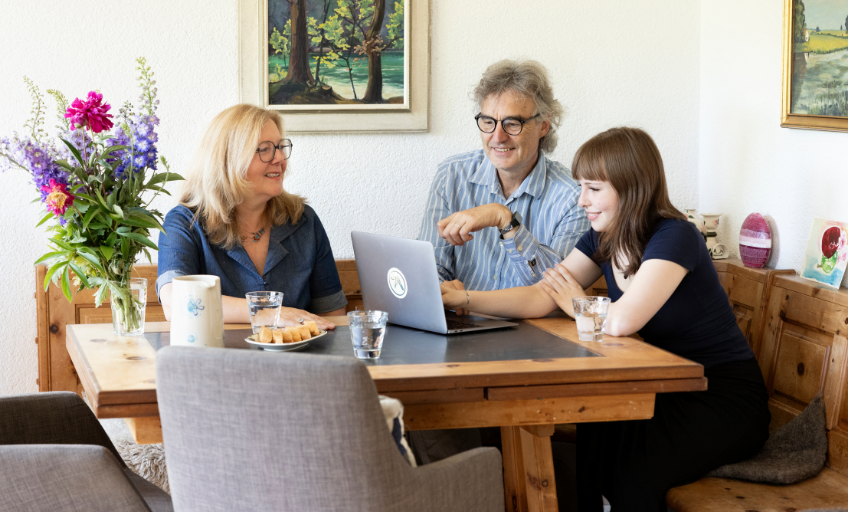
Louisa Freitag already had a favourite career choice whilst at secondary school No. 2: optician. Nevertheless, she prepared for the entrance exam to grammar school. «Everyone with good marks sat the exam, and I didn't know anyway whether I wanted to start an apprenticeship just yet,» she explains, sitting at the living room table in Schaffhausen.
She passed the exam, but on her very first day at the new school she thought: «This isn't for me. It's all far too theoretical. What's the point of this for my life?» She carried these doubts around with her for several weeks, telling her best friends that she didn't like secondary school.
After returning from secondary school to sixth form, I felt awful and thought I'd let my family down badly.
Louisa Freitag, trainee optician
Her mother, Denise, also noticed that her daughter wasn't feeling at ease. So she wasn't particularly surprised when, after six weeks at grammar school, Louisa announced that she wanted to go back to secondary school and then do an apprenticeship. «She was already a bit fed up with school and, at the same time, keen to break out of her familiar routine – school – just as many people her age want to,» she says. «Looking back, it seems to me that Louisa just wanted to prove to herself that she could cope with sixth form.» The 17-year-old simply smiles; all that is now a distant memory.
«I was a bit taken aback,» admits her father, Wolfgang. «We'd been practising for the exam with her, believing that this was the path she was meant to take. So I did wonder whether it was the right decision to give it all up after such a short time.»
Back to secondary school
The first step was to work out how to organise the transition from the cantonal school back to secondary school. Her father, Wolfgang, feared bureaucratic hurdles: «I wouldn't have been surprised if those in charge had said you couldn't just switch back and forth as you pleased.» In fact, however, both the middle school and the secondary school were very supportive and quickly helped Louisa get back to her place at her old school.
For schools, pupils returning from the short-cycle grammar school are nothing new. Statistics from the canton of Zurich show that between 10 and 20 per cent of young people return to secondary school after their probationary period at the short-cycle grammar school. The statistics do not distinguish between voluntary withdrawals and failure to pass the probationary period.
Leaving secondary school of her own accord initially unsettled Louisa. «I felt awful and lost, and thought I'd let my family down terribly.» Her father, a business graduate, emphasises, however, that after his initial surprise at her change of heart, he had no problem with his daughter not taking the direct route to university. He says that if he could start all over again, he would do an apprenticeship himself, «and become a piano maker».
Starting the search for an apprenticeship at a disadvantage
The only person disappointed by Louisa's decision was her maternal grandmother – «that such a clever girl would just walk away from sixth form like that». They had many conversations during the first few weeks, says Louisa's mother. In the course of these, one thing became clear to her once again: «My daughter knows what she wants and what she doesn't want.»
Back in secondary school, Louisa began her search for an apprenticeship some time behind the others and discovered that her preferred apprenticeship at the opticians’ where she'd done a work experience placement in Year 2 of secondary school had already been taken. So she carried on looking and tried out other professions and businesses – only to conclude that she wanted to stick with her original choice: the business that had already filled its apprenticeship place.
I knew that the apprenticeship was a very good training programme.
Denise Freitag, lawyer
Her parents didn't pressure her to find another apprenticeship. «A stopgap solution wouldn't have been the right thing to do – I was always convinced of that,» says Denise Freitag. As a lawyer specialising in social welfare, she is very familiar with the Swiss education system and the opportunities it offers. «I knew that an apprenticeship was a very good way to train.»
An apprenticeship that, she says, might better prepare young people for the challenges of the world of work than a school-leaving certificate without any specific plans for further study. Conversations with friends encouraged her and her husband to support their daughter's change of direction.
Bridging programme in the creative sector
So the motto was not to rush into anything. A 10th year at school would give Louisa the time she needed to find the right apprenticeship. The question was which bridging programme was the right one for her. She had neither academic gaps to make up nor weaknesses in her social skills.
«We then asked ourselves which school would be best for her to benefit from this extra year,» says Wolfgang Freitag, describing the situation. «I thought the International School would be a good way to improve my English,» says Louisa.
It was a challenge to apply for an apprenticeship and to pretend that it was my first choice.
Louisa Freitag, trainee optician
Her mother finally found the solution during the orientation year at the Lindenforum – which is actually a preparatory course in the arts and crafts for young people aiming to pursue training in the creative or craft sectors. However, according to its own description, this bridging programme also promotes the participants’ personal development and helps them find their way.
The year at the art school in Lohn, Schaffhausen, was «really cool», says Louisa. She spent a year exploring photography, pottery and other activities. Her mum, Denise, had already braced herself for the possibility that her daughter might come up with yet another new plan – perhaps something in the creative field. But unlike many of her classmates at the Lindenforum, Louisa has no artistic or creative ambitions. «I'm not talented enough for that,» she says of herself.
Dos and Don'ts for Parents
- Talk about your own choice of career and professional journey
- Express your expectations and wishes without making them a requirement
- Show an interest
- Taking wishes and dreams seriously
- Ask open-ended questions
- Keeping the topic of career choice in the spotlight
- Helping your child with their career choice tasks
- Developing skills, such as talking to adults and making telephone calls
- Proofreading applications
- Encourage your child; be there for them after setbacks and disappointments
- Approach: Your child decides; you support them in this
You should avoid doing this:
- Looking back, viewing early work experiences as entirely negative
- Value your child's ideas straight away
- Pushing your child
- Talking through our wishes and dreams
- Giving definitive, absolute answers (yes, no), laying down rules
- Putting pressure on your child
- Completing career choice tasks for the child
- Leaving your child to their own devices, placing too much responsibility on them
- Writing applications for your child
- Protecting your child from disappointment and unpleasant situations
- Attitude: «We know what's best for our child, and we'll guide them towards it’
Putting all their eggs in one basket
At the same time, she was pressing ahead with her application for her dream apprenticeship at the opticians’ where she'd bought her own glasses. She went for another taster session and sent off her application. Then the waiting began. Her mother recalls: «That period of uncertainty was difficult. From time to time, we encouraged her to ring again to enquire.»
For practical reasons, Louisa applied to another opticians’ shop, without really wanting to work there. «Applying for an apprenticeship and pretending that this was my first choice was a challenge,» she recalls.
Her parents thought sticking to Plan A was risky, but let Louisa have her way. «If it hadn't worked out, she would have had to start all over again,» feared Denise Freitag. Would that have been the end of the world? No, say both her mother and father, «it would have been a lesson to her».
The good news comes months after she applied: Louisa has been offered an apprenticeship at her dream company.
Her latest challenge, for the time being: during her gap year, she had a lot of free time, and attending just one day of lessons a week was no challenge at all for her. Her mother already suspected that, after a year in «chill mode», getting started on her apprenticeship would be tough.
And indeed: «I almost fell asleep at dinner at the start, and it took me months to get used to the long days at work,» says Louisa. She has now settled into her new life and is thinking about taking up the viola again. She feels at home in the team, loves her job and sees it as a stepping stone: «Perhaps I'll do the vocational baccalaureate later and go on to study after all.»
Please note: Applications must be submitted by the end of July
Many companies offering apprenticeships post their apprenticeship vacancies online on 1 August. From that date – which falls in the middle of the summer holidays – they begin accepting applications. Experience shows that companies which receive a large number of applications stop accepting further applications after just a few days.
So, anyone wishing to apply for an apprenticeship that is also attracting a lot of other applicants should have their application pack ready by 1 August at the latest – or by the date on which a particular company officially offers the apprenticeship. It's even better to have it ready before the summer holidays, so that you can enjoy them to the full.
It sometimes happens that schools do not finalise the application dossiers with their pupils for the «Career Guidance» module until after the summer holidays. For some apprenticeship places, this is too late.
You should therefore find out well in advance from when applications for a particular apprenticeship can be submitted and via which channel – by email, via the company's own online platform or by some other means? It is the parents’ responsibility to ensure that the application reaches the employer in good time.
