

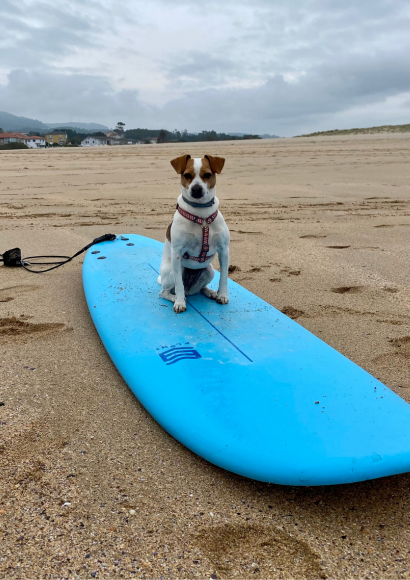
Maila's favourite phrase consists of three words: «You're coming with us!» When she hears this call, she pricks up her ears – as far as the crease in the middle allows – and comes trotting over happily. The little dog is the fifth member of our family. She came to us as a puppy nine years ago. Ever since, she has accompanied us wherever we go. For two-thirds of her doggy life , Maila has been travelling through Europe in a campervan with the rest of her pack .
More than twice round the world
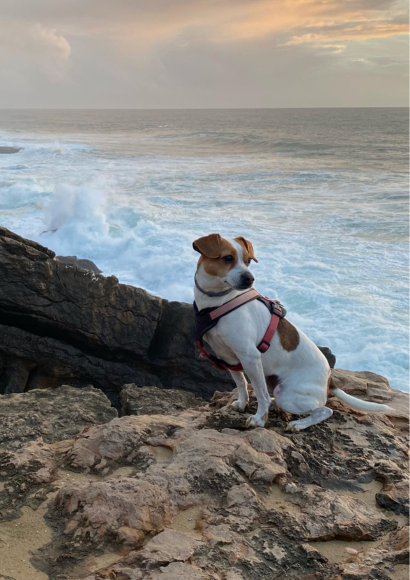
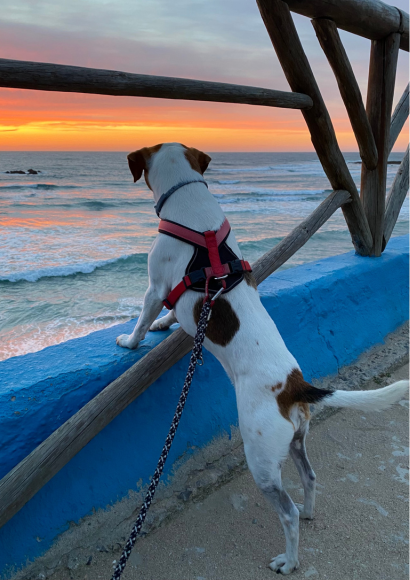
A glance at the odometer reveals that our dog has travelled more than twice around the world
. She has visited more sights than many a human. Not that she's
particularly culturally interested animal. As long as she can sniff something new or
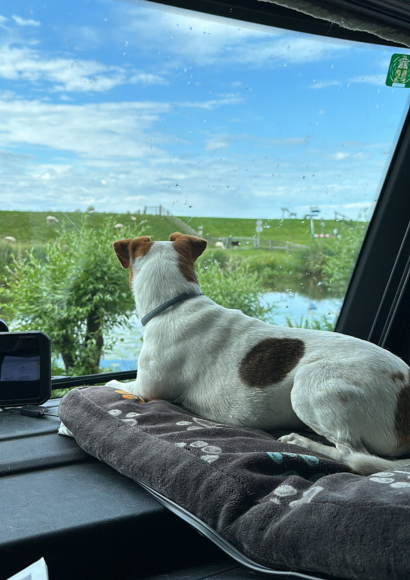
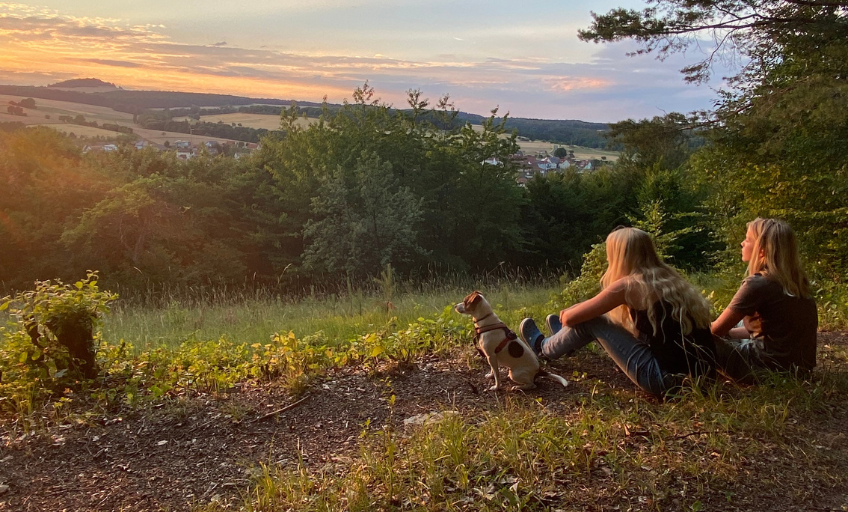
to sit on a lookout, it doesn't matter where we are – whether on the
Roman streets of Pompeii or a Viking village in Denmark.
Our daily lives would be a lot bleaker without her. Maila brightens up our day every single day. We can hardly imagine life without a dog now. It wasn't always like that.
A pet, please!
When our daughters reached nursery and school age, their desire for a pet grew ever stronger. We parents had no objection, but we did have a few reservations: I don't like mammals or birds in cages. Cat hair triggers hay fever and asthma. Whilst our eldest daughter was keen on snakes and spiders, the rest of us were rather put off by the idea. Fish? They're pretty to look at, but not very cuddly. What's left then? A dog, of course.
Which dog breed is right for us?
None of us parents grew up with dogs, so we didn't know what to expect. It seemed to be the pet that demanded the most time and attention of all. Were we prepared to devote a large part of our daily lives to looking after it?
One thing was clear: the breed would have to be suitable for first-time dog owners who aren't particularly keen on exercise. Two hours of brisk walking every day would certainly do us good, but it wouldn't be realistic. What's more, not every dog that looks pretty or cute is suitable for a family with children.
Our dog seems happier when we're out and about. The same old walk at home tends to bore her.
That's how we came across the Dansky
When we first met «Lupo», the decision was an easy one. Our children's nursery teacher was looking after her Swedish relatives’ dog. We were impressed by how friendly he was with the children.
Lupo may have been small, but to us he looked like a proper dog – no offence to little balls of fluff. So we googled the Swedish-Danish Farm Dog (Dansky). Most breeders of this breed were based far away in Scandinavia. We quickly agreed: he's exactly the right dog for us.
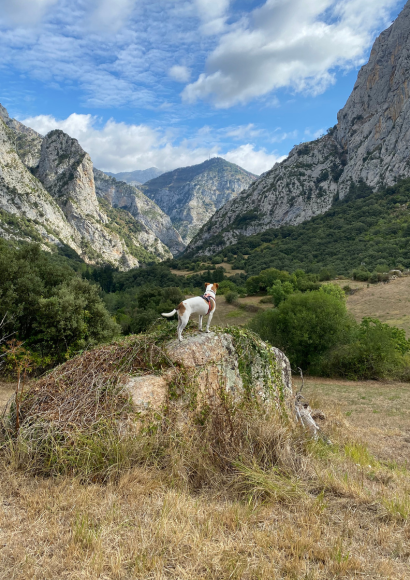
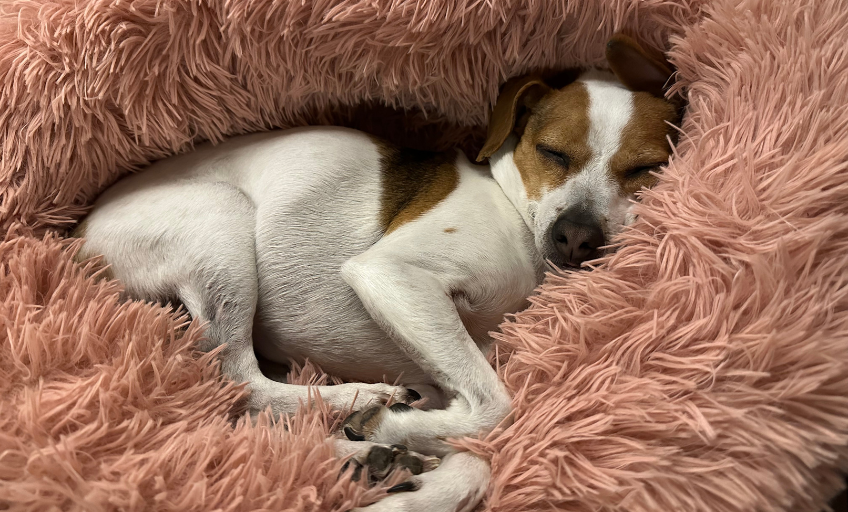
This observation has been borne out time and again over the last nine years. Like us, our dog likes to take it easy. When it rains, she'd rather stay in her cosy basket than go out. At the same time, she ’s always keen to join us on a mountain hike and doesn't seem tired even after six hours.
Maila always puts everyone in a good mood. Every morning, no matter what time the family gets out of bed, she jumps up straight away to start the day. Naturally, she starts with a bowl of dog food. She does a little dance for whoever gets up first.
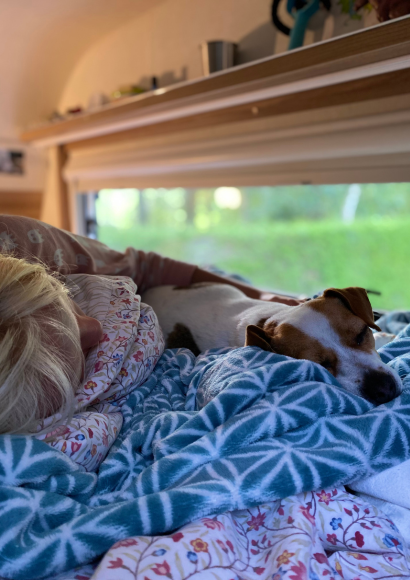
Our youngest daughter likes to sleep in a bit. As soon as we ask Maila to do so, she wakes up our little sleepyhead with a loving kiss – that is, a wet smacker on the cheek. Our little four-legged friend often snuggles up with her in bed afterwards until they both get up.
An ideal dog for travelling
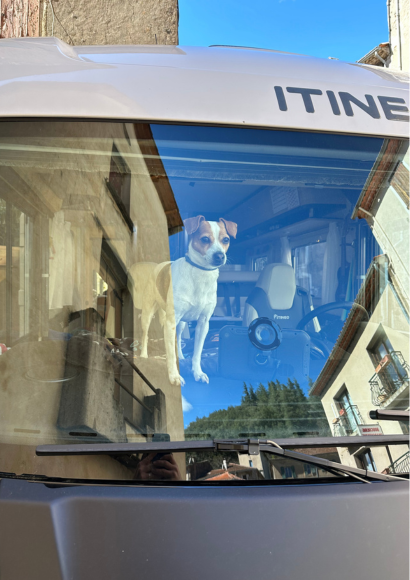
Maila doesn't mind the cramped space in the motorhome – quite the opposite. She loves it when the whole pack stays together in one place. When we're packing for our next trip at our house in France, our four-legged friend gets a bit jittery. It's only when she's allowed to wait up front in the cab – and knows she's coming along – that everything's back to normal for her.
We find that Maila is happier when we're travelling. Exploring new places and sniffing out new smells on a regular basis stimulates her mind. Going for the same old walk round the neighbourhood at home tends to dull it. She absolutely loves being a travelling dog. Out and about, she's constantly finding new trails to follow. The motorhome, on the other hand, provides a cosy pack den.
The words «food» and «sun», as well as the names of her family members, including her grandparents, make Maila feel happy.
Maila listens attentively when you speak to her. As mentioned at the start, her optimism and zest for life are heightened by certain words. Right at the top of the list is «food!». She usually reacts to this word with a little jump of joy. Next come the names of all the family members, including her grandparents.
Whenever these are mentioned, she tilts her head and looks at us intently. If she actually meets the extended pack, she leaps into the air with joy, and her whole body wags. Even the
word «sun» triggers feelings of happiness in her. Whether it's a little fire or sunlight: Maila loves lying in the warmth.
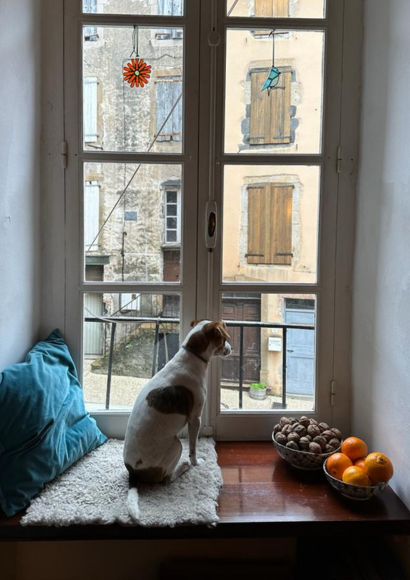
What Maila doesn't like
You can upset Maila with just a few words, even in the short term. She really doesn't like being told, «Stay there!» Nor does she like hearing, «You have to wait – it's not time yet!» Whenever she hears either of these phrases, she retreats sadly to her basket. Our little dog also hates rain and water in general. She associates the word «wet» with it.
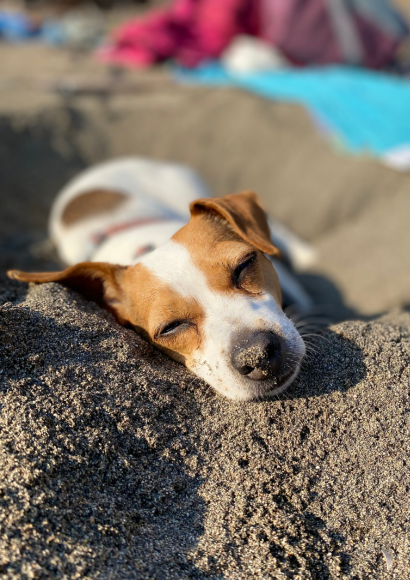
Swimming? No, thanks. I'd rather run about on the beach and dig holes. Digging for mice, by the way, is one of her favourite pastimes. That's down to her breed.
Danskys are very sociable, people-oriented and have a more even-tempered nature than terriers.
«No, she's not a terrier»
Not many people south of the Danish border are familiar with Danskys. That's why Maila is often mistaken for a Jack Russell – a small terrier. Danskys, or «Dansk-Svensk Gårdshund», are farm dogs from Scandinavia and constitute a distinct breed.
Traditionally, they were used as rat catchers, guard dogs and companion dogs for farming families, and even as hot water bottles for the bed. They are playful, friendly and cooperative. That is why they were also employed as circus dogs. For a few treats, Maila is also happy to perform all sorts of jumps and antics. Danskys are very sociable, people-oriented and have a more even-tempered nature than terriers.
A good dog for beginners
Maila was the perfect first dog for us. Of course, every dog deserves to be well-trained and cared for in a way that suits their needs. However, every first dog inevitably becomes a guinea pig – much like a first child. We certainly made the odd mistake or two.
If Maila weighed 80 kilograms, we'd probably have been a bit stricter when training her. But our little dog weighs less than some cats. Nevertheless, she listens well and follows our instructions and cues (almost always). What's more, dogs can still learn new things later on – so there's no need to worry.
Maila and her protective instinct
Danskys have a guarding instinct. If strangers come into the house or the motorhome, she barks. Often, it's enough for someone simply to walk past. To us, Maila is the sweetest and most affectionate dog in the world. Nevertheless, we have to remind visitors, especially children, not to stroke Maila in her basket. The same applies to strangers who want to touch her when she is waiting on a lead outside a shop, for example.
Our dog has never bitten anyone. He has, however, growled at or snapped at people. Many dogs behave like this when strangers approach too quickly. As we consider ourselves a friendly, hospitable and polite family, we've had to learn to accept this. On the other hand, it's reassuring to sleep in the motorhome at night with a guard dog nearby. Especially when all the curtains are drawn and the size of the animal isn't visible.
Modern nomads
You can find all the articles on «Happiness Travels With You» here.
A little grey snout
At nine years old, Maila is no longer one of the youngest. Her little snout is slowly changing colour from brown to grey. Her little teeth are starting to grow a bit crooked. Even though the life expectancy of Danskys suggests she still has a few years left, we know that eventually our life as a pack will come to an end with her. My younger daughter recently remarked that she and her sister probably won't be at home when that time comes.
To round things off, a joke comes to mind: a Catholic priest, a Protestant minister and a Jewish rabbi are discussing when human life begins. «At the moment of conception,» the priest says with certainty. «When the heart starts beating,» counters the pastor. The rabbi shakes his head and disagrees: «Life begins when the children have moved out and the dog has died.»
Essentially, that's true. Still, the thought makes me feel both amused and sad.


