In change processes, there is a phase known as the «Valley of Tears». This is the period following the initial shock and denial. It lies between the rational realisation that the change will take place and the moment when this realisation turns into emotional acceptance. This acceptance then paves the way for learning and development.
Schools are currently going through a rough patch when it comes to the use of artificial intelligence (AI). Teachers recognise that many homework and exam questions no longer work when pupils use «Chat» – as they call ChatGPT in youth slang – to quickly obtain high-quality and mostly correct answers to the questions posed.
Learning environments that have been refined over many years must be abandoned. Not because they are not good, but because the technology offers learners a shortcut that makes it impossible for them to acquire skills.
The Valley of Tears is a good time to take stock, draw up a plan and look to the future. The following guidance is intended to help schools, teachers and pupils find a practical way of dealing with this new technology.
What can «Chat» actually do?
What we refer to here as AI are large language models. These are machines that can generate new text from existing text. They break text down into very fine patterns that humans themselves cannot recognise. When they answer questions, these machines do not understand what a question is. They simply fill in the gaps automatically with a meaningful pattern that usually results in an answer.
Even when we talk to people, we don't know what's going on inside them. We simply assume that they're thinking more or less the same things we would think in the same situation. Many people do the same when interacting with chatbots. Because we talk or write to them, it feels as though the replies are coming from a person who has given the matter some thought. We then attribute intelligence, creativity, perhaps even charm or humour to them, even though they are machines.
If, at every stage of learning, it is clear that a programme has already mastered it, the experience of competence is called into question.
AI tools can turn texts into other texts. «Text» is to be understood here in a very broad sense: videos, music and programmes also take a similar form to written texts and are included here. AI tools perform exceptionally well at these tasks: they deliver better results than most people could. For schools, this means that whenever pupils need to create texts from existing material – such as writing summaries, creating educational videos or filling in gaps in texts – AI tools can do this for them.
The threshold of subject-specific competence is reached when someone can solve a particular problem better than an AI. AI is often compared to a calculator. As soon as algebra involving variables is introduced in upper secondary school, calculators can no longer solve the problems – meaning their threshold of subject-specific competence has been exceeded. The situation is different with AI: current versions can easily handle even maths problems from university modules – only a degree in mathematics allows one to exceed this threshold of expertise.
The practical benefit is lost
Almost everything that children and young people learn and do at school falls below the threshold of subject-specific competence – when it comes to texts. As soon as they build a hobby horse in craft lessons, they cross that threshold; but when they learn Franz-Wörtli, solve equations or study photosynthesis, they remain below it. AI can do what is expected of pupils better, faster and more elegantly.
This has serious consequences and is, in fact, the key change brought about by AI tools: what pupils learn when working with texts is now of little practical use. The experience of mastering a skill is a key motivational factor: those who can do something want to be able to do more and invest time and energy in achieving this. If, at every stage of learning, it is clear that a programme has already mastered it, this sense of mastery is called into question.
This also affects self-confidence and a sense of self-efficacy. What value do I bring to society if, in the foreseeable future, I can't do anything better than a chatbot?
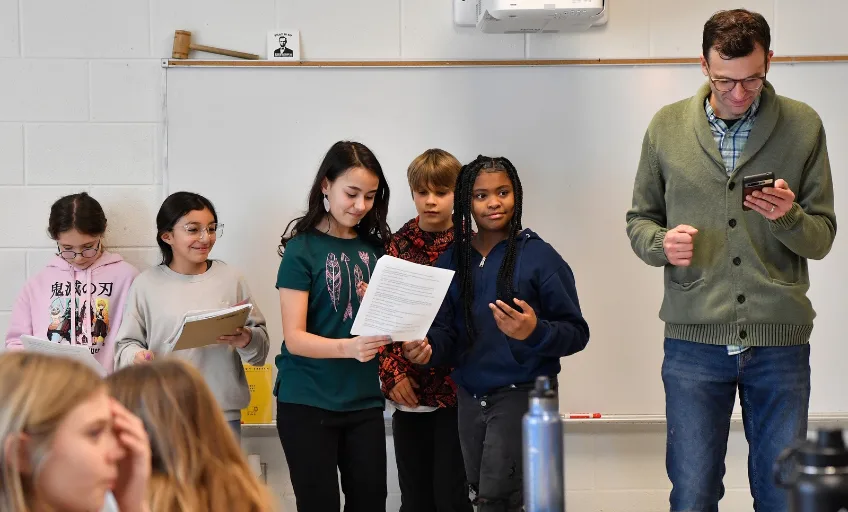
So, given these circumstances, what can teachers or parents do to encourage children to learn despite – and alongside – the possibilities offered by artificial intelligence ? The idea that AI could replace human skills is, at best, naïve. Firstly, for their own fulfilment and to lead a good life, people need to be able to do many things without relying on a machine. Secondly, they need to exceed the threshold of professional competence in specific areas in order to play an active role in working life.
A five-point plan is recommended here:
1. Focus on development
In all school activities, the focus must be on the learners’ development. They should make progress and overcome challenges. There is no point in using AI merely to give the impression that a task has been completed – after all, it is there to support their own development, not to secure a mark. However, a focus on development requires time and relationship-building: anyone who wants to support others in their development must get to know them and earn their trust.
2. Cooperative play
AI tools cannot play games or solve problems as part of a team. There are many contexts in which pupils can experience meaningful learning – without the temptation to rely on AI for every step. Those who immerse themselves in the game and work as part of a team discover their potential and link learning with emotions.
3. A sense of achievement beyond writing
Working in writing is often a stopgap solution at school, for example in foreign language lessons. The real aim is to be able to speak French – confidently, without embarrassment, even in a boulangerie in Alsace. But because 25 young people cannot all speak at the same time, they fill in worksheets instead, to learn that it is «le croissant» but «la baguette». The AI revolution is calling on teachers to move away from such written formats and to get pupils talking, doing and moving – for example, with a «shopkeeper's game» in the playground, where real croissants can only be ordered in French. This creates a sense of achievement that isn't accompanied by the feeling that AI could do it all better.
Writing flashcards, designing a learning map, highlighting text. All of these involve activities where the use of AI does not necessarily make everything easier.
4. Creating affordances
Anyone working on a computer or mobile phone has the chatbot right at their fingertips – AI features are now built into almost all programmes. Schools must therefore create opportunities where written work can be done without AI. Here's an example: many teachers, even at sixth-form colleges, are bringing exercise books back into use, even though all pupils are required to bring a laptop. Why? Writing in an exercise book helps pupils gain confidence in their own abilities and gives them the confidence to build on what they already know. A neat exercise book shows what one has achieved; it is less fleeting than AI prompts. There are many such affordances – that is, invitations to act – such as writing flashcards, designing a learning map or highlighting text. All of this leads to activities where the use of AI does not make everything easier.
5. Conscious and thoughtful use of AI
Anyone who needs to write an important text these days uses an AI tool to do so. It refines the style and corrects spelling, grammar and punctuation. This should not be banned in schools, but rather taught. Good teachers do not ban the use of AI, but help pupils to understand where it is useful, what to look out for and what the use of AI entails. It is also important here to ensure that access to AI in schools does not create inequalities – it should not matter whether parents can afford an expensive subscription or not.
The post-digital school
The worst kind of teaching: teachers use an AI tool to generate a worksheet, which pupils then complete using AI as well. When it comes purely to text-based skills, it is difficult these days to demonstrate what AI is bad at. One exception: a dialogue in dialect, such as might take place in the playground. It's easier to do this when learning experiences aren't limited to the production of texts – when children and young people engage in conversation, move around, play and create.
A school where this is possible is «post-digital». This does not mean that there are no digital activities; they simply do not take centre stage. In such a school, AI is a matter of course – a consciously considered option that nobody needs to hide. The use of AI brings no advantages in examinations because it is both a given and, at the same time, unimportant. The focus is on activities and forms of learning where AI adds little value or merely serves a supporting role. Meaningful forms of assessment might then include, for example, reflective reports, educational videos or (group) discussions, through which pupils show the teacher how they have worked, what they have learnt in the process and where questions remain unanswered.
If teachers stick to the formats commonly used today for exams and homework, pupils will constantly be faced with a choice: should I put in a lot of effort to come up with a potentially incomplete and error-prone solution myself – or, with minimal effort, have an AI generate a flawless solution?
When it comes to decisions like these, it is not enough simply to introduce rules or appeal to people's sense of moral responsibility. The temptation to use AI tools will always be very strong, even if they are banned. Young people are already doing this today during very important exams: they access «chat» functions on their mobile phones or smartwatches even when, given the format of the exam, this should not actually be possible.
Thinking in a new direction
If teachers wish to prevent this, they will inevitably have to resort to problematic methods of control and surveillance that undermine the well-being of all learners. For these reasons, it makes sense to think in the opposite direction: firstly, to change the format of assignments so that the use of AI is not even practical; secondly, to introduce a culture of error in which mistakes are genuinely seen as learning opportunities rather than problems; and thirdly, to foster a culture of honesty in which pupils are generally less likely to pretend.
It is important to recognise that school culture also plays a part in children and young people making life easier for themselves with AI and breaking the rules. They do not do this because they are lazy or stupid, but because there are sufficiently strong incentives to do so. Teachers can make a difference here.

Establishing an AI-focused school culture as the next step
At present, an examination culture free from AI-vulnerable formats remains a vision for many schools. A realistic first step is to establish an AI-based school culture through shared rules: where and for what purposes do we use AI, how do we handle it transparently, and in which types of work do we consciously choose not to use it?
Secondly, teachers and school leaders must consider whether their learning activities and assessments still make sense if pupils were able to use chatbots for them. This also requires honest discussions with the pupils. Ultimately, it is they who are called upon to act: it is about their perspectives on learning and working, and their confidence in their own abilities. Together with young people, schools can find their way out of this valley of tears.