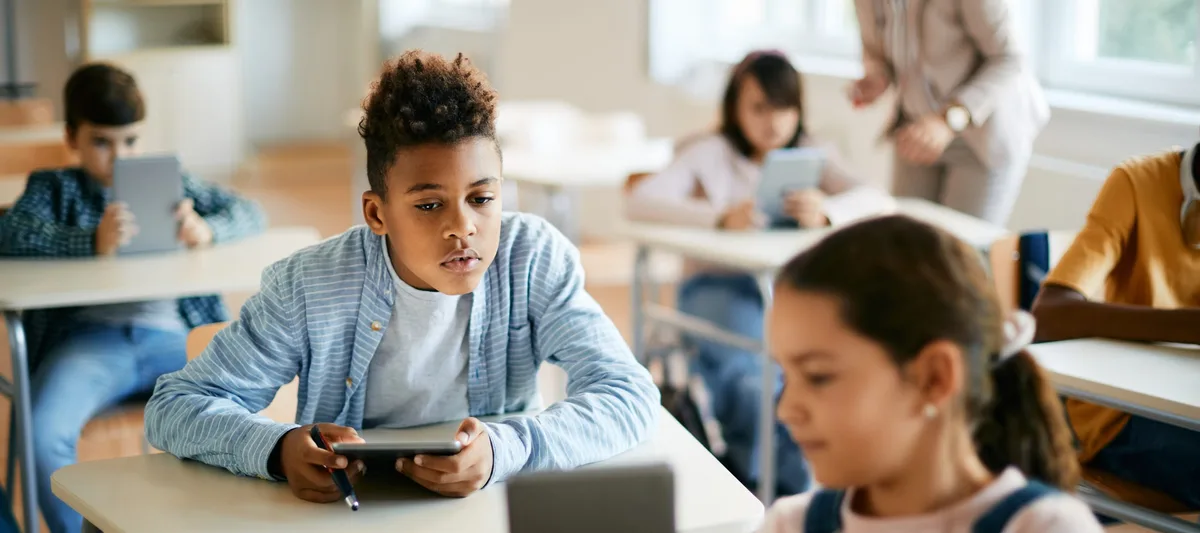
For a long time, a fundamental assumption shaped the debate on education policy: a modern school is a digital school, and more devices lead to better outcomes for everyone. Cantons and local authorities invested substantial sums in tablets, laptops and networks.
Experience from everyday school life now paints a much more nuanced picture. What matters is not whether a device is being used, but for what purpose. Digital media enrich teaching when they serve a clear educational purpose: in research, in collaborative writing, and in making complex relationships visible. Generative artificial intelligence can also support learning, provided that pupils understand how such systems work, why they can make mistakes, and what ethical questions they raise.
At the same time, there is growing evidence from both practice and research that unsupervised and unlimited use of digital media is associated with a shorter attention span, difficulty in reading longer texts in depth, and restlessness. Countries such as Sweden have therefore placed greater emphasis once again on printed teaching materials and handwriting. The focus today is less on the number of devices available and more on their moderate, well-considered use.
The dangers of the internet
With smartphones and platforms such as WhatsApp, TikTok and Snapchat, social dynamics amongst young people have changed. Conflicts no longer end when the break bell rings, but continue in the evenings in private chat groups. Cyberbullying takes the form of a demeaning photo, a hurtful meme or deliberate exclusion from a group chat. Children carry this emotional strain with them into the classroom the next morning, where it disrupts the learning environment.
A new development is the emergence of fake images generated by image generators – so-called «deepfakes» – which young people are using to embarrass their fellow pupils. The sharing of intimate images is also becoming an increasing concern for schools.
The hope that widespread access to technology would reduce social inequalities has not been realised.
Another concern relates to cyber-grooming, that is, adults deliberately making contact with minors for sexual purposes. This often begins in the chat rooms of popular gaming platforms, where perpetrators pose as peers. Because this takes place in secret, it often goes unnoticed for a long time, and adolescents are not yet able to reliably recognise manipulative intentions.
Media use as a factor exacerbating social inequalities
The hope that widespread access to technology would reduce social inequalities has not been realised. In fact, the opposite has been observed – a phenomenon known in educational research as the Matthew effect: to those who have, more will be given. Children from families with a strong educational background are more likely to make targeted use of digital tools for creative purposes and learning. Children from disadvantaged backgrounds, on the other hand, tend to use these tools passively and without guidance.
As a result, differences in vocabulary, reading comprehension and concentration may widen over the course of a pupil's school years. The latest PISA results show a widening gap between high-achieving and low-achieving young people. Media use is not the sole cause, but it does act as a contributing factor.
Tips for parents
People often ask at what age it makes sense for a child to have their own smartphone. There is no universal age guideline, but there are some tried-and-tested pointers. It helps to have rules agreed upon together, screen-free periods at mealtimes, and devices kept outside the child's bedroom at night. After all, getting enough sleep is fundamental to learning. Your own behaviour is also very important, as children closely observe how often adults reach for their mobile phones.
Genuine interest is key: if you ask about a favourite game, an influencer's posts or popular videos without making accusations, you build trust for when things do go wrong. Children should know that they can speak up at any time without having to worry about having their devices taken away.
In the case of cyberbullying, the advice is: do not respond to insults; take screenshots of messages and profiles; block the person and report them. It is then worth speaking to your form tutor or the school social worker as soon as possible; schools investigate such incidents, even if they occur outside of lessons. Support is also available via Pro Juventute's helpline on 147 and the national platform «Youth and Media».
What schools can influence
Many schools have introduced rules stipulating that personal devices must remain in pupils’ bags during the school day. The feedback has been encouraging: more face-to-face interaction during break times and fewer distractions in lessons. At the same time, Curriculum 21 teaches skills ranging from critical evaluation of sources to data protection in the «Media and IT» module . For this to be successful, teachers need time, further training and technical support.
School rules, however, end at the school gates. Many apps are designed to hold users’ attention for as long as possible, for example through endless scrolling and personalised feeds. This is where policymakers must step in. Australia has introduced a statutory minimum age for social media, whilst in the EU, the «Digital Services Act» and the proposed «EU Kids Act» place greater responsibility on big tech companies.
The digital world is an integral part of our society, and children should be able to participate in it in a way that is age-appropriate and safe.
Politicians also have a role to play
In Switzerland, the Federal Act on the Protection of Minors in the Fields of Film and Video Games, which came into force in 2025, provides an initial framework. With regard to the planned Federal Act on Communication Platforms and Search Engines, the LCH, together with other associations, is campaigning to ensure that operators are obliged to implement effective age verification measures and to refrain from using mechanisms that encourage addiction. The LCH also supports efforts to create specific criminal offences for cyberbullying and cybergrooming, thereby closing gaps in the protection of minors.
The protection of children and young people and digital participation are not mutually exclusive. The digital space is part of our society, and children should be able to participate in it in a way that is age-appropriate and safe. There is no need for alarmism; what is needed is a coordinated approach: media literacy and rules that support learning at school, guidance and discussions within the family, content designed with children in mind, and a reliable legal framework. Schools and parents do not have to tackle this alone. We can achieve more by working together.