

Jaël, a lot has happened since we last spoke three years ago. What amazes you the most?
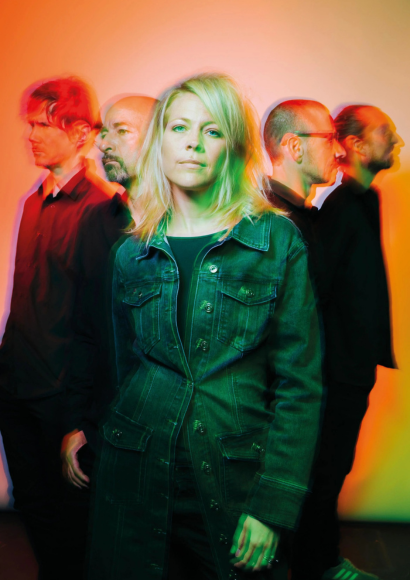
That's right! What amazes me most is getting back together with the band Lunik after a twelve-year break, and the changes that come with having two children.
Lunik split up back then following a row. To what extent did becoming parents help you to get back together?
That certainly played a part as well. Becoming a parent, but also simply growing older, shifts your perspective; you no longer see everything so strictly and can become more generous towards others – and, above all, towards yourself.
It didn't happen overnight.
The moment came when we realised we didn't want to wait until our deathbeds to resolve all the unresolved issues that had been gnawing at us for years. It was a lengthy process that began in 2019, led to reconciliation talks during the Covid-19 pandemic, and lasted almost seven years in total. During this time, a desire to make music together again grew in all of us. When I weaned my daughter in 2024 and was ready for new projects, that was the starting point for reviving Lunik.
How forgiving are you towards yourself?
I'm practising this and am certainly being less hard on myself than I was in my twenties or thirties. Last year, however, my body pulled the emergency brake in the form of a burnout and said «enough». Looking back, I'm grateful for that, even though I would have preferred to have taken a different path. But it wasn't possible. I stubbornly ignored the signals my body was sending me, which were getting stronger and stronger.
I was no longer able to be there for my children. The four-week stay in hospital helped me get back on my feet.
Jaël on her burnout
Which ones were they?
For over two years, I struggled with constant nausea, dizziness and tinnitus. I had panic attacks and, at times, could only go out if I'd taken strong tranquillisers. The quality of my sleep also got worse and worse. My nervous system was constantly overstimulated. Eventually, I no longer had the energy for my two children. No patience, no clarity of thought. My mind was just racing. By the spring of 2025, I simply couldn't function any more.
So what happened then?
My GP recommended an anthroposophical health centre. I'd originally planned to stay for just a week. My daughter was only two years old. I was plagued by feelings of guilt. But after three days, I had a complete breakdown. The «pull yourself together» mentality I'd been brought up with no longer worked. I had to admit to myself that, in that state, I couldn't be there for my children. I stayed for four weeks and the first thing I had to do was learn how to sleep again. That stabilised me.
Shortly afterwards, you also had a cycling accident in which you broke your elbow.
It was very gruelling. For weeks on end, I was unable to play the guitar or look after the house and the children on my own. Even worse were the many broken teeth and the exposed nerves that came with them. It was very painful and wearing, and it slowed everything down. But perhaps that was necessary too – so that I wouldn't immediately fall back into my old ways after the treatment.
Do you always look for faults in yourself first?
I wouldn't call it a quest to find faults. Self-awareness is also one of my core themes as a singer. I try to explore and understand myself and the world around me as deeply as possible.
You didn't have an easy start as a mum. Your son was a cry baby. Eliah is now eight years old and your daughter Liala is four. How has being a mum to two children changed for you?
At first, it was a huge relief – and a real joy – that Liala was so relaxed and easy-going. It also gave me confidence in my role as a mum, in the sense that I thought, «Hey, it is possible after all; I'm not doing everything wrong». I find it fascinating that every child reflects and triggers different issues.
Do you have an example?
With Eliah, there was so much repressed anger inside me that I wasn't even aware of. All my life I'd wanted to do everything well and do it right – especially as a mother. I set such high standards for myself. As a baby, he must surely have sensed that inner tension and conflict, and he literally screamed it right back at me. One might even speculate that he was screaming it on my behalf, because I couldn't do it myself.
When we're angry, we say: «Here comes the sabre-toothed tiger.» Then we might end up hitting a cushion.
Isn't this primarily a systemic failure? The isolated nuclear family and the balance between parenthood and work simply do not work very well. This has been demonstrated by numerous studies, for example by the sociologist Franziska Schutzbach and the Austrian political scientist Mariam Irene Tazi-Preve.
That's an important point. It will probably take several more generations and a few societal changes before mothers experience more relief. There are still so many issues to sort out. Not feeling guilty is hard work.
Motherhood only works if you have a supportive network. It isn't something you're born with; it's something you can learn step by step. What do you think?
These are good things to say; they take the pressure off. It's uncharted territory. Unfortunately, the beliefs and ideals surrounding motherhood in Switzerland tend to go in a different direction. I've heard it said, particularly by older women: «At least you're not one of those women who act as if pregnancy were an illness». All these outdated sayings, such as «A child isn't really a child» or «We managed it in the end too», reflect a harshness that women have internalised towards themselves for generations. I hope we can all adopt a more relaxed and supportive approach to motherhood.
What issues does your daughter reflect back to you?
Grief and feelings of powerlessness, of being at the mercy of others. And from an early age, she showed a tendency to want to please both her brother and me. This people-pleasing behaviour, which I was also familiar with for a long time. I stand firm against it, so that she, too, gets her own space. When I hear someone say that she's «such a good girl», it actually stresses me out.
Do you find it very difficult to cope with your children's feelings of anger or sadness?
Yes, actually. I find that difficult. Even when they get physical. It makes me feel uneasy and goes against my strong need for harmony. Yet every emotion has its own function and quality. We've now found phrases to describe them. When it comes to anger, for example, we say: «Here comes the sabre-toothed tiger», because we've already talked a lot about the «fight or flight» response. Then sometimes they'll punch a cushion.
What do you do when everyday family life all gets a bit too much for you?
Then I tell my children: «I need to pop out onto the balcony for some fresh air, or go into my room to clear my head.» I then meditate, or at least breathe in and out mindfully. My children are also used to me putting on ear defenders.
Mum's taking a break now. This attitude is also new and not something to be taken for granted.
It was a long journey to let go of the ideal of the ever-patient and loving mother who is always there for everyone. But who is always patient and understanding? I found it difficult to let go of that expectation.
How do you react when your children are arguing?
I don't intervene straight away over minor issues. Otherwise, our rule is that everyone is allowed to share their view of the dispute. It's not about finding someone to blame and punishing them. Simply listening and being heard sorts out a great deal.
Talking openly about one's feelings is something that our parents’ generation – and we ourselves – have not learnt to do.
That's why it's so important. When Liala said to me recently, after an argument with her brother: «And now let's go and see Eliah, and he can tell us what it was like for him too», I was overjoyed inside. It's so healing!
How do you organise your family life so that you can balance work and parenthood?
We have a nanny. After my health retreat, we decided to add another day of childcare. That gives me more flexibility; I'm not just working during the time the children are being looked after, and I can do something for myself now and then – whether it's exercise, a massage or simply doing nothing. It takes a lot of the stress off.
In practical terms, it makes more sense to have children in your twenties or early thirties. But for me, it would have been a disaster.
You're 47 years old. So you're right in the middle of the menopause. Are you noticing the hormonal changes quite a lot?
Yes, very much so. The hormonal turmoil manifested itself in severe mood swings, including periods of depression, bouts of sleepiness, joint pain, dry eyes and frayed nerves. It was one of the reasons for my burnout. Since then, I've been taking bioidentical hormone replacement therapy .
Perimenopause and young children – in other words, being sensitive or even exhausted whilst at the same time raising your little ones through those tough early years – is that even possible?
In terms of physical strength, it probably makes more sense to have children in your twenties or early thirties. But for me, that would have been a disaster. I needed those years for my personal development and to pursue my dream career as a singer. Besides, the menopause wasn't even on my radar. I thought it happened sometime after the age of 50.
Awareness of the symptoms of perimenopause – that is, the years leading up to a woman's last period – is also only slowly growing. Do you regret having children later in life?
No, not that – even though it's very demanding. Every stage of life probably has its own challenges, and there's no such thing as the «right» time to have children. It takes courage at every stage of life, and it's a great adventure.
What helps you avoid falling into a state of exhaustion again?
I'm getting better and better at just taking it easy. I mean, taking a more relaxed approach to things, lowering my high expectations of myself and not feeling responsible for everything. It's a slow process, but it's happening. I've also got much better at having a laugh at myself. My children have taught me that too.
And what about your job?
When I'm on a concert tour, I need one free weekend a month. If I've got several concerts in a row, I stay in a hotel. Without feeling guilty. That's the difference compared to how things used to be. The band members also take some of the emotional pressure off me. They've known me for so long. They help me to let go of my perfectionism – for example, by letting me turn up late every now and then. These are huge steps for me.
Of all bands, it's Lunik – the band that was a shambles for years – that's now giving you a sense of stability. What a lovely «cycle breaker», as you sing about on the new album. Is there another one you'd like to share?
Yes, the process of reconciliation with my parents was also very liberating. Becoming a mother brought old patterns and conditioning to the surface and, at times, led to a rather distant relationship. I really appreciate the fact that my parents listened to me. Without snide remarks, witticisms or unsolicited advice. They simply listened. I am very grateful to them for that.
In two years’ time, when you're 49, you'll be completing another seven-year cycle. What are your hopes for the next cycle?
I'm still really enjoying this fruitful period with Lunik. I think the thrill of the adrenaline rush on stage will fade at some point. I'm thinking of moving into coaching, and I'd like to trust my intuition even more – trusting that the right things will come my way at the right time. I'm curious to see how the adventure of family life unfolds, and I hope we never lose our sense of wonder.
Lunik: New album and concert tour
Double CD CYCLE BREAKER
The first CD of the double CD CYCLE BREAKER features brand-new Lunik tracks. The second CD comprises previously unreleased bootlegs from Lunik's early years, selected live versions and intimate recordings from the band's rehearsal room. You can order the new album here.
You can find the 2026 tour dates here.


